
Last updated: February 23, 2026
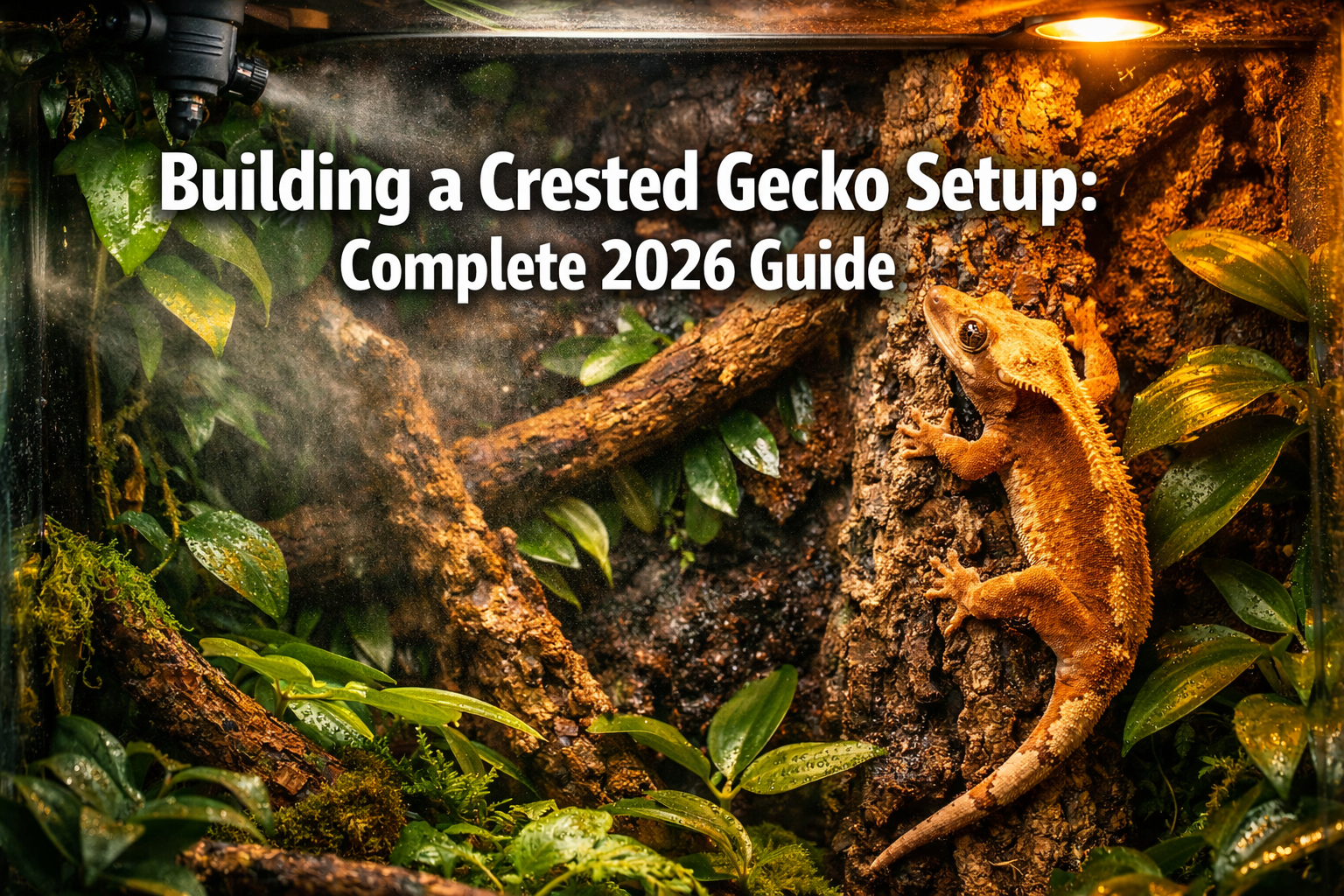
When I first started building a crested gecko setup, I quickly learned that these arboreal lizards need more than just a basic glass box. A proper crested gecko habitat requires vertical space, controlled humidity, appropriate temperature gradients, and naturalistic climbing structures that mimic their native New Caledonian rainforest environment. Getting these fundamentals right from the start makes the difference between a gecko that merely survives and one that truly thrives.
Key Takeaways
- Minimum enclosure size for adult crested geckos is 18″L x 18″W x 24″H, with vertical orientation being critical for these arboreal climbers
- Temperature range should stay between 72-78°F, with nighttime drops to 65-70°F; avoid temperatures above 82°F
- Humidity levels need to be maintained at 60-80% through daily misting, with proper ventilation to prevent stagnant air
- Bioactive substrates with cleanup crew organisms (springtails and isopods) create self-maintaining environments that reduce maintenance
- UVB lighting at 7% strength positioned 10 inches from basking branches provides essential vitamin D3 synthesis
- Multiple feeding ledges placed at different heights are essential since crested geckos rarely descend to the enclosure floor
- Baby geckos require smaller starter enclosures (12″x12″x18″) to ensure they can find food and maintain proper body condition
- Vertical climbing branches and cork bark create the three-dimensional space these geckos need for natural behaviors
Quick Answer
Building a crested gecko setup requires a vertically-oriented enclosure (minimum 18″x18″x24″ for adults), bioactive or moisture-retentive substrate, multiple climbing branches and cork bark pieces, live or artificial plants for cover, temperature control maintaining 72-78°F, humidity at 60-80%, and elevated feeding ledges. The setup should prioritize vertical space over floor area, include proper UVB lighting, and provide multiple hiding spots at different heights to accommodate their arboreal lifestyle.
What Size Enclosure Do You Need for Building a Crested Gecko Setup?
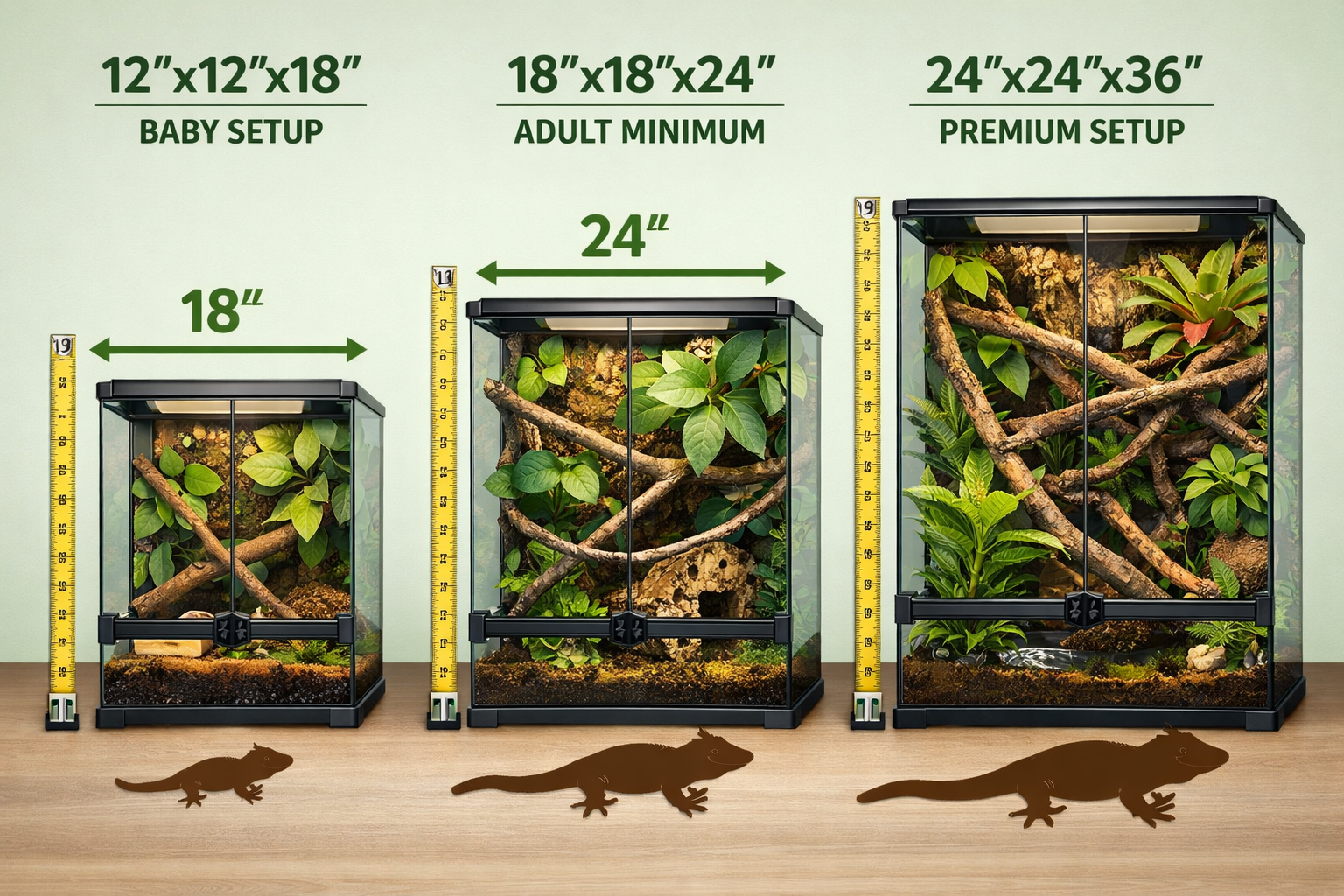
The minimum enclosure size for an adult crested gecko is 18″L x 18″W x 24″H, with vertical height being more important than floor space because these geckos are arboreal climbers that spend most of their time off the ground[1][4]. Baby crested geckos should start in smaller enclosures measuring 12″x12″x18″ to ensure they can easily locate food and water[3].
Enclosure sizing guidelines:
- Hatchlings and babies (0-3 months): 12″x12″x18″ vertical enclosure with screen top
- Juveniles (3-12 months): 12″x12″x18″ to 18″x18″x18″ depending on growth rate
- Young adults (1-2 years): 18″x18″x24″ minimum, 24″x18″x24″ preferred
- Adult crested geckos (2+ years): 18″x18″x24″ minimum, larger dimensions always better
I recommend going with larger enclosures when possible. A 24″x18″x36″ setup provides significantly more climbing space and allows for better temperature gradients[4]. Choose larger dimensions if you plan to house multiple females together or want to create an elaborate bioactive display.
Common mistake: Many new keepers buy adult-sized enclosures for baby geckos. This makes it difficult for young geckos to hunt insects effectively and can lead to feeding problems. Start small and upgrade as your gecko grows.
Decision rule: Choose a 12″x12″x18″ if your gecko weighs under 15 grams, an 18″x18″x24″ for geckos 15-35 grams, and consider 24″ dimensions for geckos over 35 grams or breeding groups.
For those interested in specific morphs, our selection of crested geckos for sale includes hatchlings, well-started babies, juveniles, and young adults, each requiring appropriately-sized housing.
How Do You Control Temperature When Building a Crested Gecko Setup?
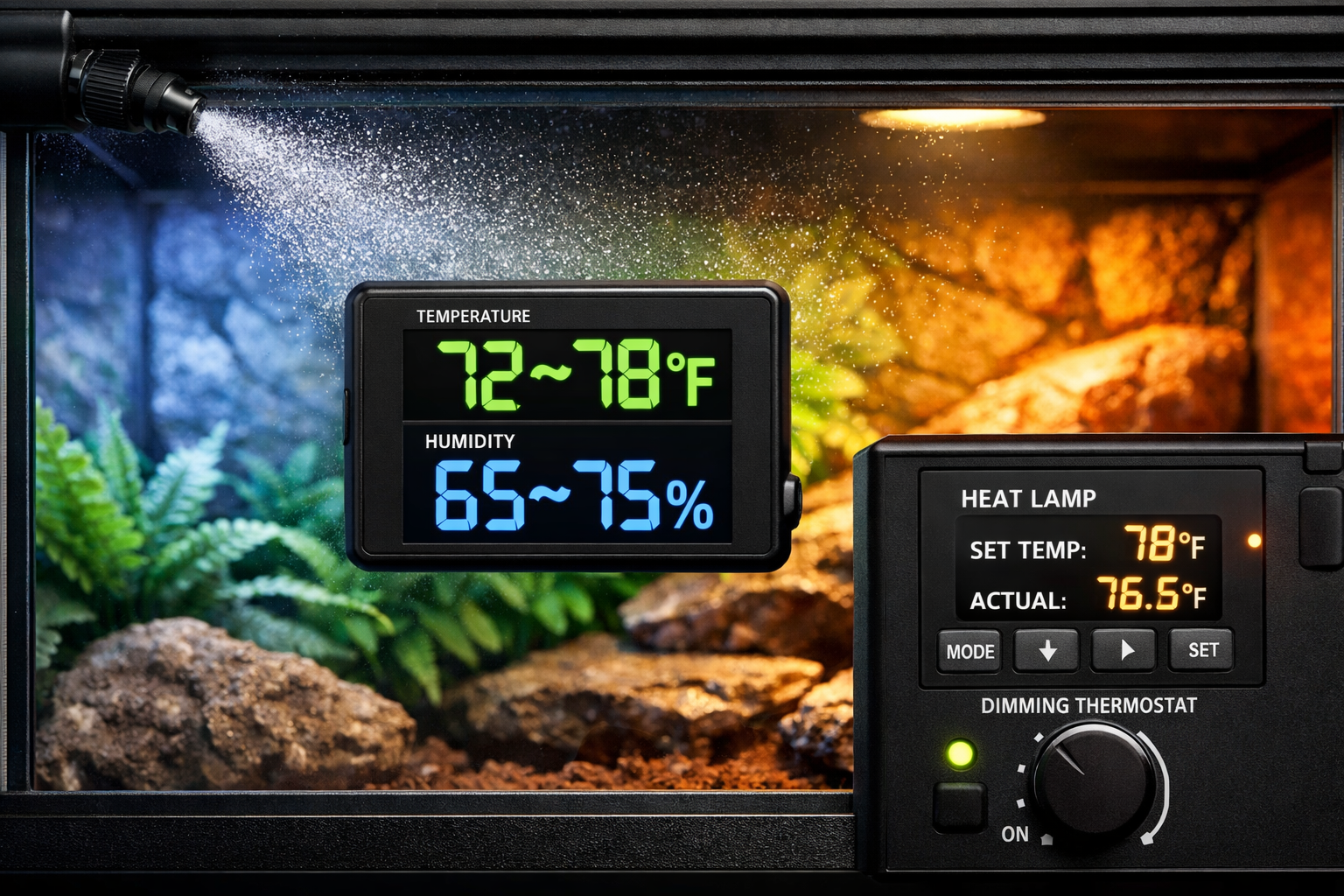
Crested geckos require ambient temperatures between 72-78°F during the day with nighttime drops to 65-70°F, and temperatures should never exceed 82°F for extended periods as this can cause heat stress[2][8]. Unlike many reptiles, crested geckos don’t need basking spots or heat lamps in most home environments.
Temperature management strategies:
- Room temperature homes (68-75°F): No supplemental heating needed; natural room temperature is sufficient
- Cool environments (below 68°F): Use low-wattage heat bulb or ceramic heat emitter on dimming thermostat set to 27°C/80°F[2]
- Warm climates (above 78°F): Position enclosure in coolest room, use fans for air circulation, avoid direct sunlight
- Monitoring equipment: Digital thermometer with probe placed at mid-height level, not near heat source
I’ve found that dimming thermostats provide the safest heat regulation because they gradually adjust power output rather than switching on and off like traditional thermostats[2]. Position the thermostat probe at the warmest area of the enclosure to prevent overheating.
Temperature gradient setup:
- Place any heat source on one side of the enclosure
- Create a 3-5°F difference between warm and cool sides
- Ensure the coolest area stays within safe range (72-75°F)
- Monitor both warm and cool zones with separate thermometers
Edge case: In extremely cold climates where room temperature drops below 60°F at night, you may need a low-wattage heat cable or under-tank heater on the back wall (not bottom) controlled by a thermostat. Never use heat rocks or bottom heat with arboreal species.
The key is maintaining stable temperatures without hot spots. Crested geckos tolerate cooler temperatures better than excessive heat, which can be fatal.
What Humidity Levels Are Required for Building a Crested Gecko Setup?
Crested gecko enclosures need humidity levels between 60-80%, achieved through daily misting sessions and moisture-retentive substrate, with proper ventilation to prevent stagnant air and bacterial growth[2][8]. Humidity should fluctuate naturally, peaking after misting and dropping between sessions.
Humidity maintenance routine:
- Morning misting: Thoroughly spray enclosure at dawn or early morning, focusing on plants and substrate
- Evening misting: Second misting session in late afternoon or evening
- Misting duration: 30-60 seconds until water droplets form on surfaces and plants
- Dry-out period: Allow enclosure to dry partially between mistings; surfaces should not stay constantly wet
Humidity monitoring equipment:
- Digital hygrometer with probe (analog gauges are often inaccurate)
- Position probe at mid-height level where gecko spends most time
- Check readings twice daily to ensure proper range
- Replace hygrometer batteries regularly for accurate readings
I use an automatic misting system for my breeding collection, but hand-misting works perfectly well for single enclosures. The benefit of hand-misting is you can observe your gecko’s behavior and check for any health issues during the process.
Substrate impact on humidity:
- Bioactive substrate: Maintains humidity longer, requires less frequent misting
- Paper towel: Dries quickly, needs more frequent misting
- Coconut fiber: Good moisture retention, affordable option
- Sphagnum moss: Excellent humidity retention, can be used as substrate layer or in humid hides
Common mistake: Maintaining 80% humidity constantly without allowing dry-out periods. This creates perfect conditions for bacterial and fungal growth. Humidity should peak at 70-80% after misting and drop to 50-60% before the next session.
For comprehensive habitat guidance, check out our crested gecko habitat setup resource.
What Substrate Works Best When Building a Crested Gecko Setup?
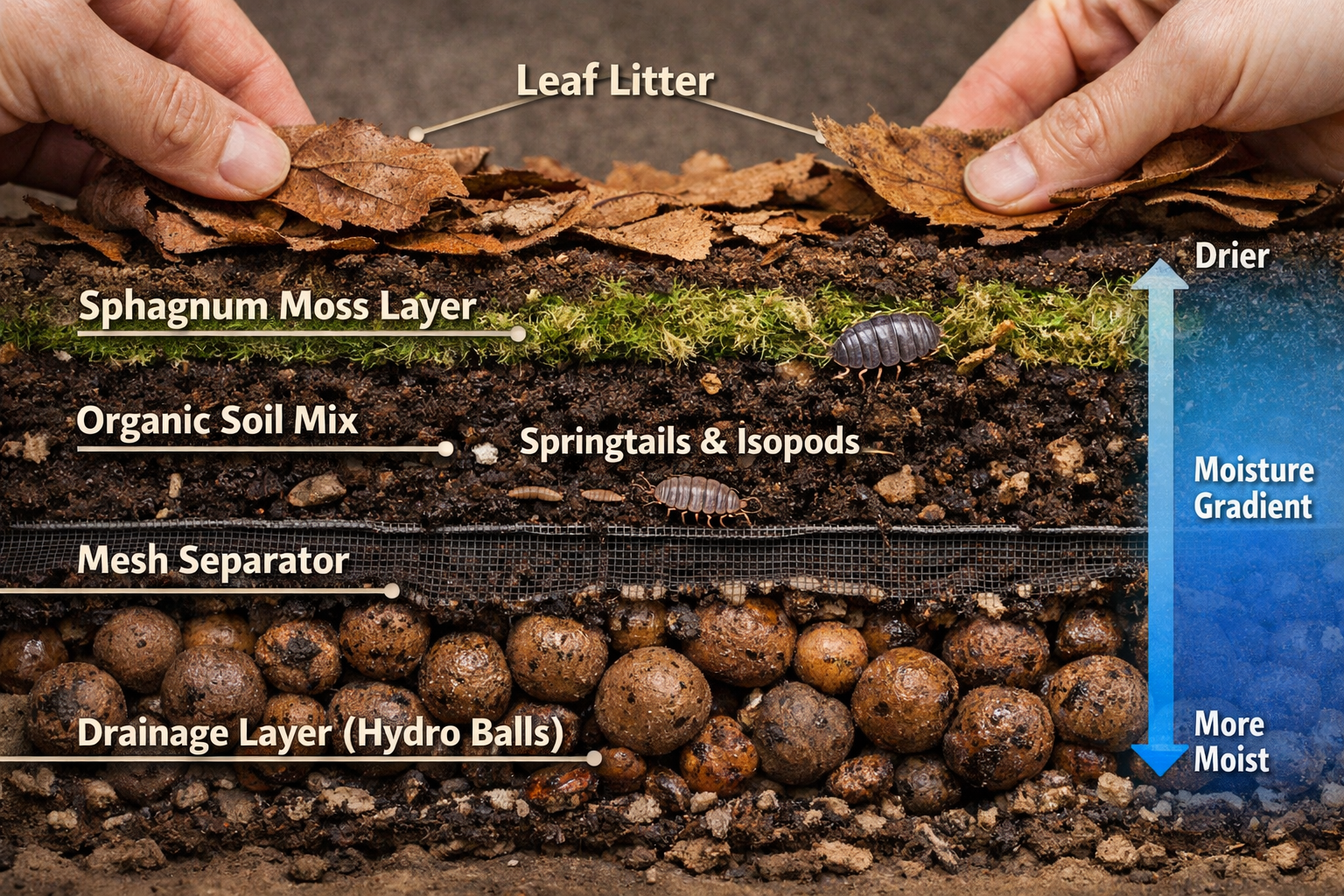
Bioactive substrate composed of organic topsoil without added fertilizers, supplemented with sphagnum moss and leaf litter, creates the most naturalistic and low-maintenance environment for crested geckos[2]. This substrate supports beneficial cleanup crew organisms while maintaining proper humidity levels.
Bioactive substrate recipe:
- Base layer (40%): Organic topsoil or coconut coir, screened to remove large particles
- Drainage material (optional): 1-2 inches of hydro balls or LECA if using deep substrate
- Mesh separator: Weed barrier fabric between drainage and substrate layers
- Substrate mix (40%): Blend topsoil with coconut fiber and orchid bark
- Moss layer (10%): Sphagnum moss distributed throughout top layer
- Leaf litter (10%): Oak, magnolia, or Indian almond leaves on surface
Cleanup crew organisms (CUC):
- Springtails: Process mold and fungus, maintain substrate health
- Dwarf white isopods: Break down feces and shed skin
- Dairy cow isopods: Larger species for processing organic waste
- Giant canyon isopods: Optional for larger enclosures with heavy bioload
Add cleanup crew after substrate has been moist for 2-3 weeks to allow beneficial bacteria to establish[2]. Start with cultures of 25-50 springtails and 10-15 isopods per 18x18x24 enclosure.
Alternative substrate options:
| Substrate Type | Pros | Cons | Best For |
|---|---|---|---|
| Paper towel | Easy to clean, monitors waste | No humidity retention, not naturalistic | Quarantine, babies, sick geckos |
| Coconut fiber | Good humidity, affordable | Can mold if too wet, not bioactive | Budget setups, beginners |
| Reptile carpet | Reusable, no ingestion risk | Harbors bacteria, difficult to clean | Not recommended for crested geckos |
| Bioactive mix | Self-maintaining, naturalistic | Higher initial cost, learning curve | Display enclosures, experienced keepers |
I’ve maintained bioactive setups for years and find they require less maintenance than paper towel once established. The cleanup crew processes waste continuously, and I only need to remove uneaten insects and spot-clean feeding ledges.
Decision rule: Choose paper towel if you’re quarantining a new gecko or treating health issues. Choose bioactive if you want a low-maintenance, naturalistic display that benefits from live plants and natural waste processing.
What Lighting Do You Need When Building a Crested Gecko Setup?
Crested geckos require 7% UVB lighting with the closest branches positioned approximately 10 inches from the bulb, yielding a UV-Index of around 2, because these geckos are crepuscular and need UVB exposure for vitamin D3 synthesis[2]. Despite being labeled as nocturnal by some sources, research shows they benefit significantly from proper UVB provision.
UVB lighting specifications:
- Bulb type: T5 HO linear fluorescent or LED UVB at 7% strength
- Length: Match enclosure width (18″ bulb for 18″ wide enclosure)
- Placement: Mounted inside screen top or on top of mesh (reduces UVB by 30-40%)
- Distance: 8-12 inches from highest basking branches
- Replacement schedule: Every 12 months even if bulb still produces visible light
Photoperiod requirements:
- Spring/Summer (March-September): 14 hours light, 10 hours dark
- Fall/Winter (October-February): 10-12 hours light, 12-14 hours dark
- Timer control: Essential for consistent day/night cycles
- Gradual transitions: Adjust photoperiod by 15-30 minutes weekly when changing seasons
I use a simple outlet timer to control both UVB and any low-wattage LED plant lights. This ensures consistent lighting schedules even when I’m traveling or have irregular schedules.
Visible light options:
- LED plant lights: Support live plant growth, create naturalistic appearance
- 6500K color temperature: Mimics natural daylight, enhances gecko colors
- Low wattage: 5-15 watts sufficient for most enclosures
- Avoid: High-output lights that produce excessive heat
Common mistake: Using only visible light without UVB provision. While crested geckos can survive without UVB if given proper vitamin D3 supplementation, they display better coloration, more natural behaviors, and improved bone health with appropriate UVB exposure[2].
Edge case: If your enclosure receives indirect natural sunlight through a window (not direct sun, which causes overheating), you may reduce artificial UVB duration but should still provide some supplemental UVB since window glass blocks most beneficial wavelengths.
For temperature-specific guidance, visit our crested gecko temperature guide.
What Décor and Climbing Structures Are Essential for Building a Crested Gecko Setup?
Building a crested gecko setup requires multiple vertical climbing branches, cork bark pieces, and live or artificial plants positioned at different heights to create three-dimensional climbing routes, with a minimum of 2-3 hiding spots distributed throughout the enclosure[1]. Crested geckos are arboreal and need extensive climbing opportunities to exhibit natural behaviors.
Essential décor elements:
Vertical climbing structures:
- Cork bark flats or rounds (various sizes for texture variety)
- Bamboo poles or branches (secured diagonally and vertically)
- Driftwood or mopani wood pieces
- Magnetic ledges for feeding stations
- All branches should be 0.5-1.5 times the gecko’s body width for secure gripping
Hiding spots (minimum 3):
- Upper hide: Cork bark tube or hollow near top for nighttime security
- Mid-level hide: Positioned along climbing routes for daytime rest[1]
- Lower hide: Optional humid hide with sphagnum moss for shedding
Plant selection:
Live plants (bioactive setups):
- Pothos (Epipremnum aureum): Hardy, fast-growing, excellent cover
- Snake plant (Sansevieria): Tolerates varying humidity, sturdy leaves
- Bromeliads: Create natural water catchments, add visual interest
- Ferns: Boston fern, bird’s nest fern provide dense cover
- Philodendron: Climbing variety adds vertical coverage
Artificial plants (low-maintenance option):
- Choose silk or fabric plants over plastic (more realistic, better grip)
- Position multiple plants at different heights
- Secure firmly to prevent collapse under gecko’s weight
- Mix sizes and leaf shapes for naturalistic appearance
Feeding ledge placement:
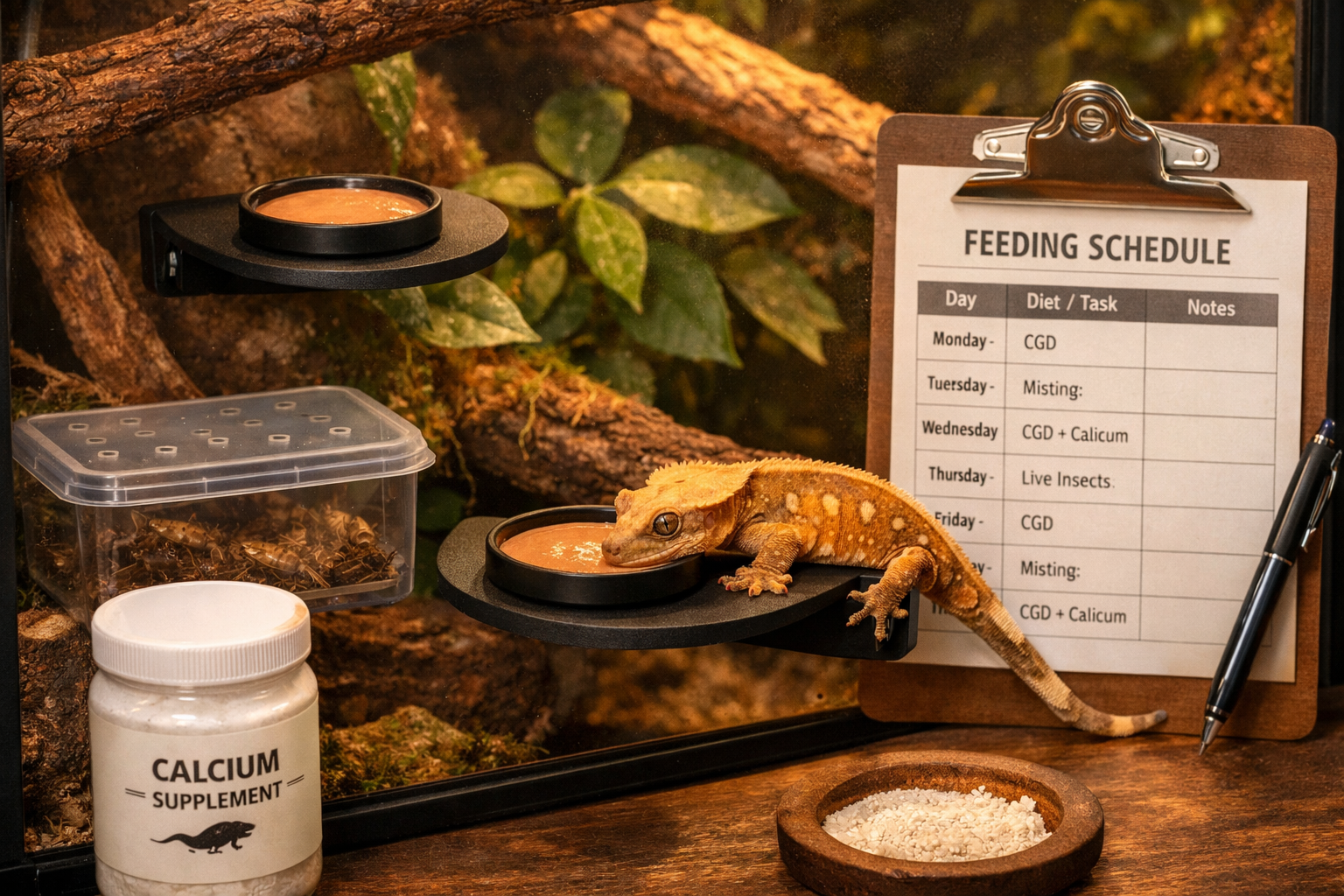
I always install dual feeding ledges at different heights because crested geckos rarely venture to the enclosure floor[2]. Position one ledge at upper-third height and another at mid-level to accommodate individual preferences.
- Magnetic ledges: Easy to reposition, removable for cleaning
- Suction cup ledges: Less expensive but may lose grip over time
- Height placement: 12-18 inches from substrate for primary ledge
- Accessibility: Ensure gecko can easily reach ledge from nearby branches
Décor arrangement strategy:
- Start with largest pieces (background, major branches) first
- Create diagonal climbing routes from bottom to top
- Add horizontal resting spots at multiple levels
- Fill gaps with plants for security and visual barriers
- Leave some open space for movement and hunting
- Test stability by gently shaking all structures
Common mistake: Overcrowding the enclosure with too much décor. While crested geckos appreciate dense coverage, they also need open pathways for moving between levels. Aim for 60-70% coverage with 30-40% open space.
For visual inspiration, browse our crested gecko photo gallery showing various setup styles.
How Do You Set Up Feeding and Water Sources When Building a Crested Gecko Setup?
Crested geckos require elevated feeding ledges positioned at mid to upper enclosure heights for their powdered diet, with separate dishes for live insects, and while they drink water droplets from misting, a small water dish provides backup hydration[7]. These geckos rarely descend to the ground, making elevated food placement critical for proper nutrition.
Feeding station setup:
Powdered diet ledge:
- Mount magnetic or suction cup ledge 12-18 inches from substrate
- Use small glass or ceramic dish (1-2 inch diameter)
- Position near favorite resting spot for easy access
- Replace diet every 24-48 hours to prevent spoilage
Live insect feeding:
- Use separate ledge or feed in different area to prevent diet contamination
- Offer appropriately-sized crickets, dubia roaches, or black soldier fly larvae
- Dust insects with calcium + D3 powder before offering
- Feed insects 2-3 times weekly for adults, 4-5 times weekly for juveniles
Water provision:
- Primary hydration: Water droplets from daily misting sessions
- Backup water dish: Small dish (2-3 inches) on enclosure floor or mounted ledge
- Change frequency: Daily to prevent bacterial growth
- Dish type: Shallow to prevent drowning risk, easy to clean
Feeding schedule for different life stages:
| Life Stage | Powdered Diet | Live Insects | Feeding Frequency |
|---|---|---|---|
| Hatchling (0-3 months) | Small amount daily | Small crickets 5-7x/week | Every day |
| Juvenile (3-12 months) | Fresh every other day | Medium insects 4-5x/week | 5-6 days/week |
| Young adult (1-2 years) | Fresh every 2-3 days | Large insects 3-4x/week | 4-5 days/week |
| Adult (2+ years) | Fresh every 2-3 days | Large insects 2-3x/week | 3-4 days/week |
I recommend using commercial crested gecko diet as the staple food source. Quality brands contain balanced nutrition specifically formulated for these geckos. For detailed nutritional information, see our crested gecko diet guide.
Supplementation protocol:
- Calcium + D3: Dust insects before feeding 2-3x weekly
- Multivitamin: Dust insects 1x weekly
- Powdered diet: Already contains balanced nutrition, no additional supplementation needed
- Rotation: Alternate between calcium and multivitamin dustings
Common mistake: Placing food dishes on the enclosure floor. Crested geckos are arboreal and may not find ground-level food, leading to malnutrition. Always elevate feeding stations to encourage natural feeding behaviors.
Decision rule: If your gecko consistently ignores elevated food, try repositioning the ledge near their favorite resting branch. Some geckos are particular about feeding locations and prefer specific areas of their territory.
What Are the Steps for Building a Crested Gecko Setup from Start to Finish?
Building a complete crested gecko setup involves selecting the enclosure, installing substrate and drainage layers, positioning hardscape elements, adding plants, installing lighting and heating equipment, establishing proper environmental parameters, and cycling the enclosure for 2-3 weeks before introducing your gecko. Following this systematic approach ensures a stable, healthy environment.
Complete setup process:
Step 1: Enclosure preparation (Day 1)
- Clean enclosure thoroughly with reptile-safe disinfectant
- Rinse completely and allow to dry
- Position enclosure in final location away from direct sunlight and drafts
- Ensure nearby electrical outlets for equipment
Step 2: Drainage and substrate installation (Day 1)
- Add 1-2 inches drainage layer (hydro balls or LECA) if using bioactive
- Place mesh separator over drainage material
- Mix substrate components in large container
- Add 2-4 inches substrate to enclosure
- Moisten substrate until damp but not waterlogged
- Add sphagnum moss and leaf litter to surface
Step 3: Hardscape placement (Day 1-2)
- Position background if using (cork bark flat, foam background)
- Install largest branches and cork bark pieces first
- Create diagonal climbing routes from bottom to top
- Add horizontal resting branches at multiple levels
- Secure all pieces to prevent shifting (silicone, zip ties, wire)
- Test stability by gently shaking structures
Step 4: Plant installation (Day 2)
- Plant live plants in substrate, starting with largest specimens
- Position plants to create visual barriers and hiding spots
- Add smaller plants to fill gaps and create depth
- Secure artificial plants with suction cups or wire if needed
- Ensure plants don’t block climbing routes
Step 5: Equipment installation (Day 2)
- Mount UVB fixture on screen top or inside enclosure
- Install any heating equipment with thermostat probe placement
- Position thermometer and hygrometer probes at mid-height
- Install feeding ledges at appropriate heights
- Add water dish in accessible location
Step 6: Environmental cycling (Days 3-21)
- Run all equipment for 2-3 weeks before adding gecko
- Monitor temperature and humidity daily
- Adjust misting schedule to achieve proper humidity range
- Add cleanup crew organisms after 1-2 weeks (bioactive setups)
- Make any necessary adjustments to décor or equipment
Step 7: Final preparation (Day 21+)
- Verify temperature stays within 72-78°F range
- Confirm humidity cycles between 50-80% with misting
- Check all branches and structures remain secure
- Clean any dust or debris from surfaces
- Prepare feeding station with fresh diet
Step 8: Introducing your gecko (Day 21+)
- Acclimate gecko in transport container for 30 minutes
- Place gecko on mid-level branch, not on substrate
- Minimize handling and observation for first 3-5 days
- Offer food on second day in enclosure
- Monitor feeding, defecation, and behavior
Bioactive cycling specifics:
For bioactive setups, the 2-3 week cycling period allows beneficial bacteria to establish and cleanup crew populations to grow[2]. During this time, you may notice white mold growth on wood and leaves; this is normal and will be consumed by springtails within a few weeks.
Budget considerations:
- Basic setup: $200-300 (enclosure, simple décor, basic equipment)
- Mid-range setup: $300-500 (better enclosure, live plants, quality lighting)
- Premium bioactive: $500-800+ (large enclosure, extensive plants, automated systems)
I always recommend investing in quality lighting and temperature control equipment even if you economize on décor. You can gradually upgrade plants and hardscape, but proper environmental parameters are critical from day one.
Common mistake: Rushing to add the gecko before the enclosure has stabilized. New setups often experience humidity and temperature fluctuations for the first week. Cycling the enclosure allows you to identify and fix issues before your gecko’s health is at risk.
As one of the leading crested gecko breeders in the USA, CBReptile.com provides healthy geckos raised in properly designed habitats, ensuring they transition smoothly to your new setup.
What Common Mistakes Should You Avoid When Building a Crested Gecko Setup?
The most common mistakes when building a crested gecko setup include using enclosures that are too small or horizontally-oriented, maintaining excessive temperatures above 80°F, providing inadequate climbing structures, placing food on the enclosure floor, and failing to establish proper humidity cycling. These errors can lead to stress, feeding problems, and health issues.
Critical mistakes and solutions:
1. Horizontal enclosure orientation
- Problem: Crested geckos are arboreal and need vertical space
- Solution: Always choose tall enclosures over wide ones; minimum 24″ height
- Impact: Horizontal setups cause stress and limit natural climbing behaviors
2. Excessive heat exposure
- Problem: Temperatures above 82°F cause heat stress and can be fatal
- Solution: Monitor temperatures carefully, position enclosure in cool area
- Impact: Heat stress symptoms include gaping, lethargy, refusing food, and in severe cases, death
3. Inadequate climbing opportunities
- Problem: Sparse décor with limited vertical routes
- Solution: Install multiple branches, cork bark, and plants at various heights
- Impact: Stressed geckos, poor muscle development, abnormal behaviors
4. Ground-level food placement
- Problem: Placing food dishes on substrate instead of elevated ledges
- Solution: Mount feeding ledges 12-18 inches from substrate[2]
- Impact: Geckos may not find food, leading to weight loss and malnutrition
5. Constant high humidity without dry periods
- Problem: Maintaining 80% humidity 24/7 without allowing surfaces to dry
- Solution: Allow humidity to drop to 50-60% between misting sessions
- Impact: Bacterial growth, respiratory infections, skin problems
6. Using adult enclosures for baby geckos
- Problem: Babies struggle to find food in large spaces
- Solution: Start with 12″x12″x18″ for hatchlings, upgrade as they grow[3]
- Impact: Feeding difficulties, stress, failure to thrive
7. No UVB provision
- Problem: Relying solely on dietary D3 without UVB lighting
- Solution: Install 7% UVB bulb with proper distance and photoperiod[2]
- Impact: Reduced bone health, poor coloration, less active behavior
8. Overcrowding with multiple geckos
- Problem: Housing males together or keeping too many geckos in small space
- Solution: Never house males together; provide 18″x18″x24″ minimum per gecko
- Impact: Fighting, stress, injuries, competition for resources
9. Inadequate quarantine procedures
- Problem: Adding new gecko directly to established enclosure or collection
- Solution: Quarantine all new geckos for minimum 60-90 days in separate room
- Impact: Disease transmission, parasite spread, potential loss of entire collection
10. Using unsafe substrate materials
- Problem: Sand, walnut shell, or other particulate substrates that cause impaction
- Solution: Use coconut fiber, bioactive mix, or paper towel only
- Impact: Intestinal blockage if ingested during feeding
Edge cases to consider:
Cohabitation challenges: While female crested geckos can sometimes be housed together, I’ve found that even compatible females may develop territorial aggression over time. Always have backup enclosures ready if separation becomes necessary.
Seasonal adjustments: In regions with significant seasonal temperature variation, you may need heating in winter and cooling strategies in summer. Monitor conditions year-round and adjust equipment accordingly.
Plant toxicity: While most common terrarium plants are safe, avoid pothos (mildly toxic if ingested in large quantities) if your gecko shows unusual interest in eating plants. Choose confirmed safe species like bromeliads and ferns.
For comprehensive setup guidance, review our crested gecko habitat guide for additional best practices.
How Do You Maintain a Crested Gecko Setup Long-Term?
Long-term maintenance of a crested gecko setup involves daily misting and feeding checks, weekly spot-cleaning and water changes, monthly deep cleaning of surfaces and dishes, quarterly substrate maintenance, and annual equipment replacement for UVB bulbs and other aging components. Consistent maintenance prevents health issues and keeps the environment stable.
Daily maintenance tasks (5-10 minutes):
- Mist enclosure 1-2 times (morning and evening)
- Check temperature and humidity readings
- Observe gecko for normal behavior and appearance
- Remove any uneaten insects from previous feeding
- Verify water dish is clean and filled
- Check that feeding ledge diet is fresh (replace if older than 48 hours)
Weekly maintenance tasks (15-20 minutes):
- Spot-clean visible feces from branches and surfaces
- Remove dead leaves or plant material
- Wipe down glass viewing panels with damp cloth
- Change water dish completely
- Inspect all equipment for proper function
- Check that all branches and décor remain secure
Monthly maintenance tasks (30-45 minutes):
- Deep clean feeding dishes with reptile-safe disinfectant
- Remove and clean any removable décor items
- Trim or prune live plants as needed
- Inspect UVB bulb for proper output (use UV meter if available)
- Check thermostat calibration with separate thermometer
- Add additional leaf litter or moss to bioactive setups
Quarterly maintenance tasks (1-2 hours):
- Partial substrate replacement (non-bioactive setups)
- Deep clean of all glass surfaces inside and out
- Inspect and tighten any loose branches or structures
- Evaluate cleanup crew populations (add more if needed)
- Check all electrical connections and cords for damage
- Assess overall setup and make improvements
Annual maintenance tasks:
- Replace UVB bulb even if still producing visible light
- Replace substrate completely (non-bioactive) or refresh top layers (bioactive)
- Deep clean entire enclosure with full tear-down
- Replace any worn or damaged equipment
- Upgrade plants or décor as desired
- Evaluate enclosure size for growing geckos
Bioactive setup maintenance:
Bioactive enclosures require less frequent deep cleaning because the cleanup crew processes waste continuously[2]. I only perform full tear-downs every 18-24 months for bioactive setups versus every 6-8 months for non-bioactive enclosures.
Bioactive-specific tasks:
- Monitor cleanup crew populations monthly
- Add supplemental food for isopods if populations decline (fish flakes, vegetables)
- Remove any pest species (grain mites, fungus gnats) if they appear
- Refresh leaf litter every 2-3 months
- Prune plants regularly to prevent overgrowth
Seasonal adjustments:
Summer (warmer months):
- Reduce or eliminate supplemental heating
- Increase ventilation if temperatures rise above 78°F
- May need to reduce misting frequency if ambient humidity increases
- Monitor for overheating during heat waves
Winter (cooler months):
- Add or increase supplemental heating if room temperature drops
- May need to increase misting frequency due to dry indoor air from heating systems
- Adjust photoperiod to simulate natural seasonal changes
- Monitor for drafts from windows or doors
Record keeping:
I maintain a simple log for each enclosure tracking:
- Feeding dates and food types offered
- Shedding events (should occur every 3-4 weeks)
- Weight measurements (monthly for growing juveniles, quarterly for adults)
- Any health concerns or behavioral changes
- Maintenance tasks completed and dates
- Equipment replacement dates
This documentation helps identify patterns and catch potential problems early. For example, if shedding frequency decreases or feeding response declines, you can check recent environmental changes or maintenance history.
Common maintenance mistake: Neglecting to replace UVB bulbs annually. These bulbs lose UVB output long before visible light diminishes, so a bulb may appear to work fine while providing no beneficial UVB radiation.
For specific care requirements across different morphs, explore our collection of crested gecko morphs and their individual needs.
What Are the Best Practices for Building a Crested Gecko Setup in 2026?
The best practices for building a crested gecko setup in 2026 emphasize bioactive substrates with cleanup crew organisms, appropriate UVB lighting that recognizes crested geckos as crepuscular rather than strictly nocturnal, larger enclosure sizes than historical minimums, and naturalistic décor that provides three-dimensional climbing opportunities. Modern husbandry has evolved significantly based on research and keeper experience.
Current best practices:
1. Bioactive methodology
Modern crested gecko keeping increasingly favors bioactive setups that create self-sustaining microcosms. These systems reduce maintenance, provide more naturalistic environments, and improve overall gecko health through exposure to beneficial bacteria and natural behaviors[2].
Bioactive advantages:
- Self-processing waste through cleanup crew organisms
- More stable humidity levels from living substrate
- Mental stimulation from complex environment
- Reduced cleaning frequency and labor
- Better odor control through natural decomposition
2. UVB provision as standard practice
While older care sheets often described crested geckos as nocturnal animals that don’t need UVB, research now shows they are crepuscular (active at dawn and dusk) and benefit significantly from UVB exposure[2]. Providing 7% UVB lighting is now considered best practice rather than optional.
UVB benefits:
- Natural vitamin D3 synthesis
- Improved calcium metabolism and bone health
- Enhanced coloration and activity levels
- More natural circadian rhythms
- Reduced dependence on dietary supplementation
3. Larger enclosure standards
While 18″x18″x24″ remains the accepted minimum for adult crested geckos, the trend in 2026 is toward larger enclosures when possible. Many experienced keepers now recommend 24″x18″x36″ or larger for single adults to provide more environmental enrichment[4].
4. Temperature moderation
Modern husbandry emphasizes keeping crested geckos cooler rather than warmer, with ideal temperatures in the 72-75°F range and careful avoidance of temperatures above 80°F. This reflects better understanding of their native New Caledonian climate and sensitivity to heat stress.
5. Enrichment and complexity
Contemporary setups focus on creating complex, three-dimensional environments with multiple climbing routes, varied textures, and visual barriers. This goes beyond basic functionality to provide mental stimulation and encourage natural behaviors.
Enrichment elements:
- Multiple branch types and diameters for varied grip surfaces
- Cork bark in various forms (flats, tubes, rounds)
- Live plants that move and respond to gecko movement
- Varied substrate textures and depths
- Multiple feeding stations at different heights
6. Individual customization
Rather than one-size-fits-all approaches, modern keepers customize setups based on individual gecko preferences. Some geckos prefer dense coverage while others like more open space; some feed readily from elevated ledges while others prefer specific locations.
Customization strategies:
- Observe gecko’s preferred resting spots and optimize those areas
- Adjust feeding station placement based on individual feeding response
- Modify humidity and temperature within safe ranges to match preferences
- Adapt décor density to gecko’s personality (shy versus bold)
7. Preventive health monitoring
Best practices now include regular weight monitoring, visual health checks during daily maintenance, and proactive veterinary care rather than waiting for obvious illness. Digital scales and basic record-keeping help catch problems early.
8. Ethical sourcing and genetics
In 2026, responsible keepers prioritize obtaining crested geckos from reputable breeders who maintain genetic diversity and health screening. CBReptile.com, as one of the best crested gecko breeders in the USA, provides healthy animals with known genetics and proper care history.
Choosing quality geckos:
- Select from established breeders with transparent practices
- Verify gecko has been feeding consistently on prepared diet
- Confirm appropriate weight and body condition for age
- Request information about lineage and genetics
- Ensure proper quarantine protocols from breeder
9. Technology integration
Modern setups increasingly incorporate technology for monitoring and automation:
- Automated misting systems with programmable schedules
- Digital thermostats with smartphone connectivity
- Temperature and humidity data logging
- Webcams for remote observation
- LED lighting with programmable day/night cycles
10. Sustainability considerations
Contemporary keepers consider environmental impact when building setups:
- LED lighting for energy efficiency
- Sustainably-sourced cork bark and wood
- Organic, pesticide-free plants
- Reusable and recyclable materials when possible
- Water conservation through efficient misting
Integration with broader collection:
For keepers maintaining multiple species, crested gecko setups can share equipment and practices with related species like gargoyle geckos. However, always house species separately and maintain strict quarantine protocols between enclosures.
As a leading online reptile store, CBReptile.com provides not only quality animals but also guidance on modern husbandry practices that reflect current best practices.
FAQ: Building a Crested Gecko Setup
Q: Can I use a horizontal aquarium for a crested gecko?
A: No, crested geckos need vertical enclosures because they are arboreal climbers. A horizontal aquarium doesn’t provide adequate climbing height and will stress your gecko. Always choose enclosures that are taller than they are wide, with minimum dimensions of 18″x18″x24″ for adults.
Q: Do crested geckos need a heat lamp?
A: Most crested geckos don’t need heat lamps if room temperature stays between 72-78°F. Only add supplemental heating if your room drops below 68°F, and use a low-wattage heat source on a dimming thermostat to prevent overheating above 80°F.
Q: How often should I mist my crested gecko enclosure?
A: Mist twice daily, once in the morning and once in the evening, for 30-60 seconds until water droplets form on surfaces. Allow the enclosure to partially dry between misting sessions; humidity should cycle between 50-60% (dry period) and 70-80% (after misting).
Q: Can I keep two crested geckos together?
A: Never house male crested geckos together as they will fight. Females can sometimes cohabitate in enclosures 24″x18″x36″ or larger, but monitor closely for aggression. Each gecko needs its own feeding station and hiding spots, and you must have backup enclosures ready if separation becomes necessary.
Q: What’s the best substrate for crested geckos?
A: Bioactive substrate made from organic topsoil, coconut fiber, sphagnum moss, and leaf litter provides the most naturalistic and low-maintenance option. For simpler setups, coconut fiber works well. Paper towel is best for quarantine or treating sick geckos. Avoid sand, walnut shell, or other particulate substrates that cause impaction.
Q: Do I need live plants or can I use fake ones?
A: Both work, but live plants provide better humidity regulation, air quality, and naturalistic appearance. If using artificial plants, choose silk or fabric varieties over hard plastic. Live plants require appropriate lighting but contribute to bioactive ecosystem health.
Q: How long should I wait before putting my gecko in a new setup?
A: Run the enclosure for 2-3 weeks before adding your gecko. This cycling period allows you to verify temperature and humidity stability, establish beneficial bacteria in bioactive setups, and identify any equipment issues before your gecko’s health is at risk.
Q: Where should I place feeding ledges in the enclosure?
A: Install feeding ledges at mid to upper height, approximately 12-18 inches from the substrate. Crested geckos rarely descend to the ground, so elevated feeding stations are essential. Use magnetic or suction cup ledges that can be easily repositioned and removed for cleaning.
Q: How often do I need to replace the UVB bulb?
A: Replace UVB bulbs every 12 months even if they still produce visible light. UVB output degrades over time while visible light remains, so a bulb may appear functional while providing no beneficial UVB radiation. Mark replacement dates on your calendar.
Q: What temperature is too hot for crested geckos?
A: Temperatures above 82°F cause heat stress in crested geckos, and prolonged exposure to temperatures above 85°F can be fatal. Ideal temperature range is 72-78°F during the day with nighttime drops to 65-70°F. If your room regularly exceeds 80°F, position the enclosure in the coolest area and use fans for air circulation.
Q: Can baby crested geckos go straight into adult-sized enclosures?
A: No, hatchlings and small babies should start in 12″x12″x18″ enclosures where they can easily locate food and water. Large enclosures make it difficult for babies to hunt insects effectively and can lead to feeding problems. Upgrade to adult-sized enclosures when geckos reach 15-20 grams.
Q: Do crested geckos need a water dish if I mist daily?
A: While crested geckos primarily drink water droplets from misting, a small backup water dish provides additional hydration security. Place a shallow 2-3 inch dish on the enclosure floor or on a ledge, and change the water daily to prevent bacterial growth.
Conclusion
Building a crested gecko setup that supports long-term health and natural behaviors requires attention to several critical factors: vertical enclosure orientation with minimum dimensions of 18″x18″x24″ for adults, temperature management maintaining 72-78°F, humidity cycling between 60-80%, appropriate UVB lighting at 7% strength, bioactive or moisture-retentive substrate, extensive climbing structures and plants, and elevated feeding stations. Modern husbandry in 2026 emphasizes larger enclosures when possible, bioactive methodology with cleanup crew organisms, and recognition that crested geckos benefit from UVB provision despite being crepuscular rather than diurnal.
Your next steps for building a crested gecko setup:
- Select your enclosure: Choose a vertically-oriented terrarium appropriate for your gecko’s size (12″x12″x18″ for babies, 18″x18″x24″ minimum for adults, larger if possible)
- Gather equipment: Purchase UVB lighting, thermometer, hygrometer, misting bottle or system, and any necessary heating equipment with thermostat
- Choose your substrate approach: Decide between bioactive (more naturalistic, lower maintenance) or simple substrate (easier for beginners, less initial investment)
- Acquire décor and plants: Collect cork bark, branches, live or artificial plants, and feeding ledges to create three-dimensional climbing environment
- Set up and cycle: Install all components, run the system for 2-3 weeks while monitoring and adjusting parameters
- Source your gecko: Obtain a healthy crested gecko from a reputable breeder with transparent care practices and genetic information
- Introduce and monitor: Place your gecko in the prepared enclosure and observe feeding, behavior, and health closely during the first weeks
The investment in building a proper crested gecko setup pays dividends through reduced health problems, lower long-term maintenance, and the satisfaction of watching your gecko thrive in an environment that meets all its biological needs. Whether you’re setting up your first enclosure or upgrading an existing one, following these evidence-based practices ensures your crested gecko will have the best possible home.
For those ready to add a crested gecko to a properly prepared habitat, CBReptile.com offers an extensive selection of morphs including harlequin, flame, tiger, pinstripe, and dalmatian varieties, all raised with proper husbandry and available as hatchlings, well-started babies, juveniles, and young adults.
Remember that building the setup is just the beginning. Consistent daily maintenance, ongoing environmental monitoring, and willingness to adjust your approach based on your individual gecko’s needs will ensure long-term success. The crested gecko community continues to refine best practices, so stay engaged with current research and experienced keepers to provide the best possible care.
For additional reptiles for sale and comprehensive care resources, visit our online reptile store. You can also find quality reptiles for sale online from various reputable sources.
References
[1] Building A Crested Gecko Habitat – https://www.cbreptile.com/building-a-crested-gecko-habitat/
[2] Crested Gecko Setup How Setup Complete Crested Gecko Terrarium – https://exoticdirect.co.uk/news/crested-gecko-setup-how-setup-complete-crested-gecko-terrarium/
[3] The Care And Maintenance Of A Crested Gecko – https://www.thebiodude.com/blogs/gecko-caresheets/the-care-and-maintenance-of-a-crested-gecko
[4] Crested Gecko Care Sheet – https://dubiaroaches.com/blogs/gecko-care/crested-gecko-care-sheet
[7] Crested Gecko Care – https://www.pangeareptile.com/blogs/blog/crested-gecko-care
[8] Crested Gecko Care Sheet Reptifiles – https://www.zenhabitats.com/blogs/reptile-care-sheets-resources/crested-gecko-care-sheet-reptifiles