
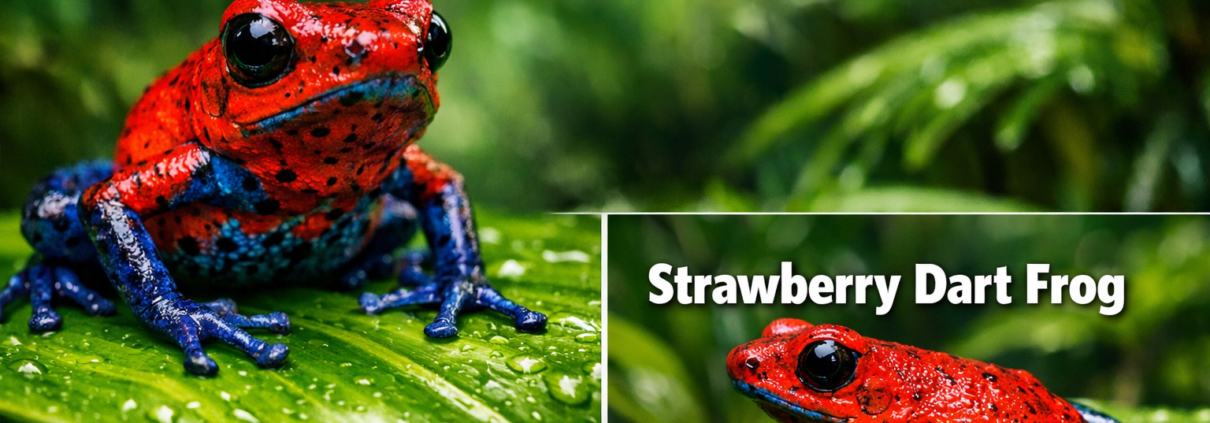
Strawberry Dart frog
Last updated: April 14, 2026
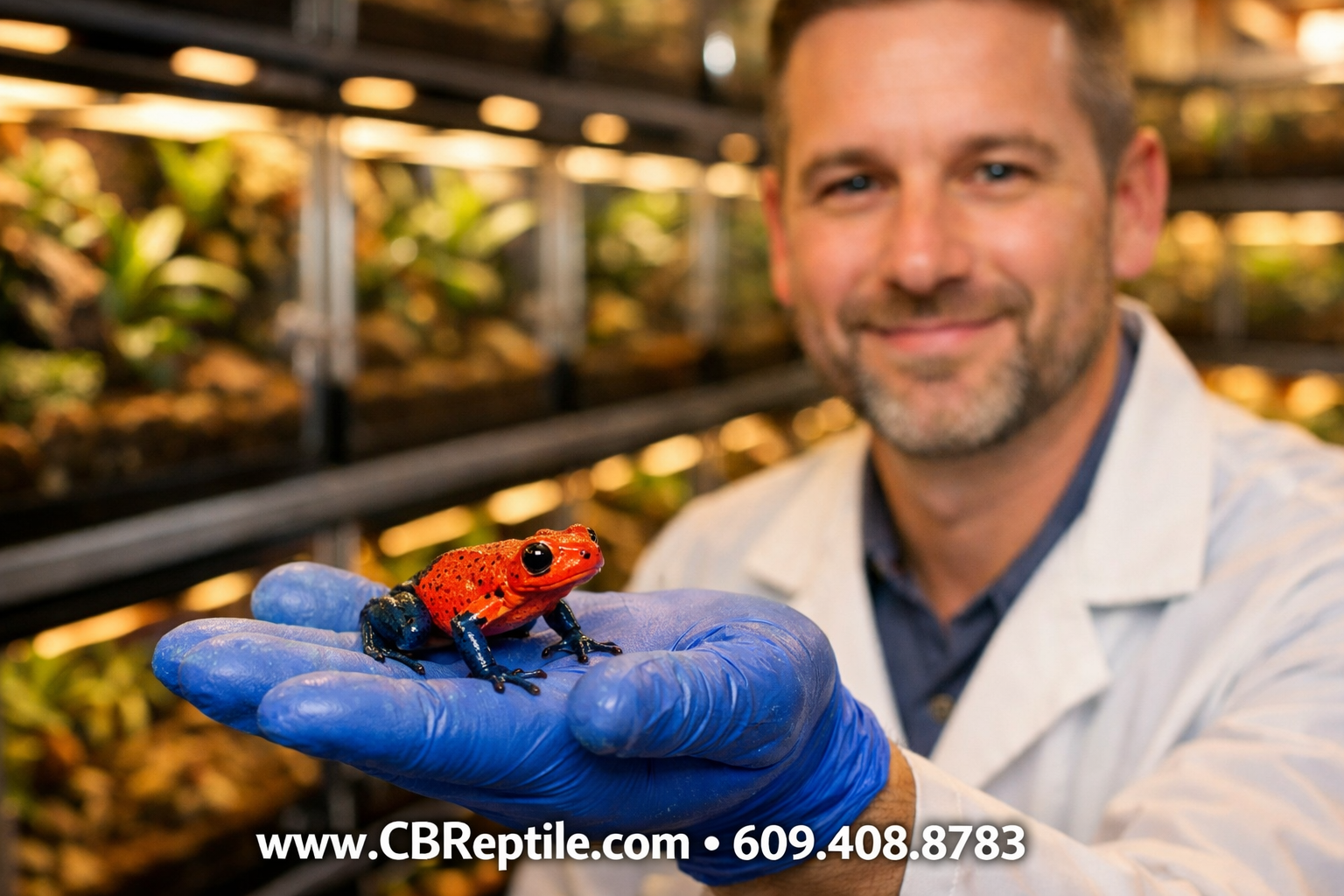
Quick Answer: The strawberry dart frog (Oophaga pumilio) is a small, brilliantly colored poison dart frog native to Central America, particularly Panama and Costa Rica. In captivity, it thrives in a warm, humid bioactive vivarium and feeds primarily on fruit flies and springtails. Captive-bred specimens are safe to handle cautiously and make stunning display animals for intermediate-to-advanced keepers.
No products found which match your selection.
Key Takeaways
- 🐸 The strawberry dart frog (Oophaga pumilio) comes in over 30 recognized color morphs, from classic red-and-blue to yellow, orange, and green variants.
- 🌿 They need a bioactive vivarium with 80–100% humidity, temperatures of 72–80°F, and live tropical plants.
- 🦟 Diet in captivity consists almost entirely of small fruit flies (Drosophila melanogaster and D. hydei) dusted with vitamin and calcium supplements.
- ⚠️ Wild-caught specimens are toxic; captive-bred frogs lose their toxicity because the alkaloids come from their wild diet.
- 🏪 CB Reptile has a real animal biologist on site and is one of the top sources for healthy, captive-bred poison dart frogs for sale in the USA.
- 📦 CB Reptile ships overnight to ensure live arrival of every animal.
- 💡 Beginners should start with a single specimen or a proven pair, not a group, to manage territorial behavior.
- 🔬 Strawberry dart frogs are obligate egg-feeders — females feed unfertilized eggs to tadpoles, making their parental care unique among frogs.
- 🌎 Most wild populations are found on Bocas del Toro archipelago islands in Panama, where geographic isolation drove extreme color variation.
What Exactly Is the Strawberry Dart Frog?
The strawberry dart frog (Oophaga pumilio) is a small dendrobatid frog measuring roughly 17–22 mm as an adult. It belongs to the family Dendrobatidae and is one of the most studied poison dart frog species in the world due to its extraordinary color diversity and complex parental behavior.
Key biological facts:
- Scientific name: Oophaga pumilio (formerly Dendrobates pumilio)
- Adult size: 17–22 mm (about 0.7–0.9 inches)
- Lifespan: 10–15 years in captivity with proper care
- Native range: Caribbean lowlands of Costa Rica, Nicaragua, and Panama
- Wild toxicity: Skin alkaloids sourced from mites and ants in their wild diet; captive-bred frogs are non-toxic
- IUCN status: Least Concern, though habitat loss is an ongoing pressure (IUCN Red List, 2022)
The species name pumilio means “dwarf” in Latin, which fits perfectly — these are tiny frogs with outsized personalities. Males are highly territorial and will wrestle rivals. Females are attentive mothers who transport individual tadpoles to water-filled bromeliads and return regularly to feed them unfertilized eggs.
Pull quote: “The strawberry dart frog doesn’t just look remarkable — its parental behavior is among the most complex documented in any amphibian species.”
How Many Strawberry Dart Frog Color Morphs Exist?
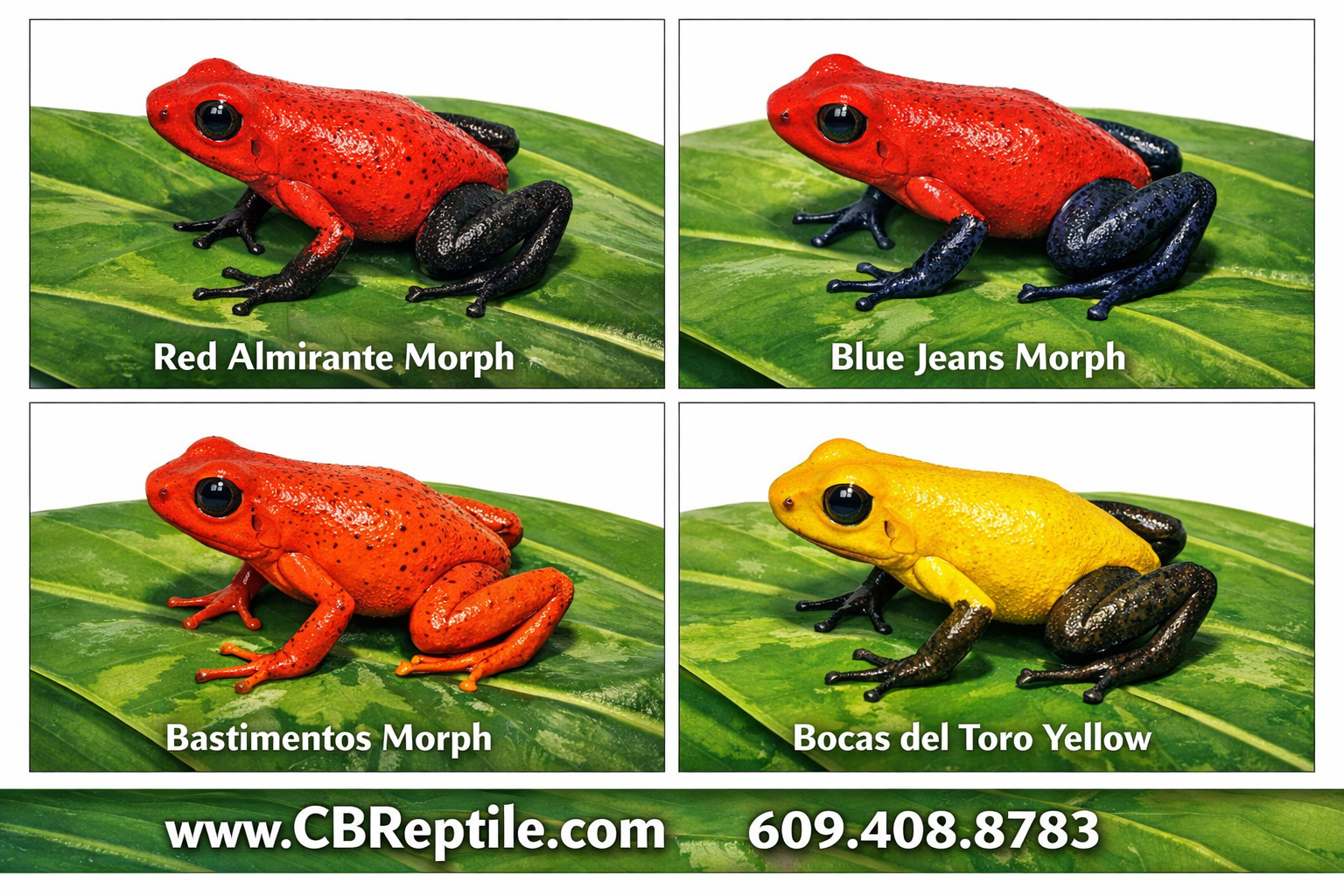
There are over 30 recognized geographic color morphs of Oophaga pumilio, each tied to a specific island or region. This makes the strawberry dart frog one of the most visually diverse vertebrate species on the planet.
Most Popular Morphs in the Hobby
| Morph Name | Primary Color | Origin |
|---|---|---|
| Almirante | Bright red, blue legs | Almirante, Panama |
| Blue Jeans | Red body, blue/navy legs | Costa Rica mainland |
| Bastimentos | Orange-red, black spots | Isla Bastimentos, Panama |
| Bocas del Toro | Yellow-orange, spotted | Bocas del Toro, Panama |
| Cristobal | Green, black reticulation | Isla Cristobal, Panama |
| Solarte | Dark red, minimal patterning | Isla Solarte, Panama |
| El Dorado | Bright yellow | El Valle, Panama |
| Uyama | Red-orange, heavy spotting | Uyama, Panama |
| Punta Laurel | Pale orange, fine spots | Punta Laurel, Panama |
| Darklands | Deep red, near-black legs | Darklands, Panama |
Choose a morph based on your goals:
- For beginners: Blue Jeans or Almirante are the most forgiving and widely available.
- For display impact: El Dorado (yellow) or Cristobal (green) create a striking contrast against live plants.
- For breeding projects: Bastimentos and Bocas del Toro are popular among hobbyists who want to document morph-specific behavior.
Common mistake: Mixing morphs from different populations. Even though they’re the same species, cross-morph breeding is discouraged in the hobby because it dilutes the genetic integrity of each geographic population. Keep morphs separate.
What Does a Strawberry Dart Frog Need in Its Enclosure?
A strawberry dart frog needs a tall, planted vivarium with consistently high humidity, stable warm temperatures, and live microfauna in the substrate. This is not a beginner setup — it requires planning and some investment upfront.
Enclosure Size
- Single frog or pair: A 10-gallon vertical vivarium (12″W x 12″D x 18″H) is the minimum.
- Small group (1 male, 2 females): A 20-gallon vertical or an 18″x18″x24″ Exo Terra is more appropriate.
- Avoid wide, low tanks: Strawberry dart frogs use vertical space and climb frequently.
Environmental Parameters
| Parameter | Target Range |
|---|---|
| Daytime temperature | 74–80°F (23–27°C) |
| Nighttime temperature | 68–74°F (20–23°C) |
| Humidity | 80–100% |
| Ventilation | Moderate cross-flow |
| Lighting | 10–12 hours/day, low-intensity UVB optional |
Substrate and Plants
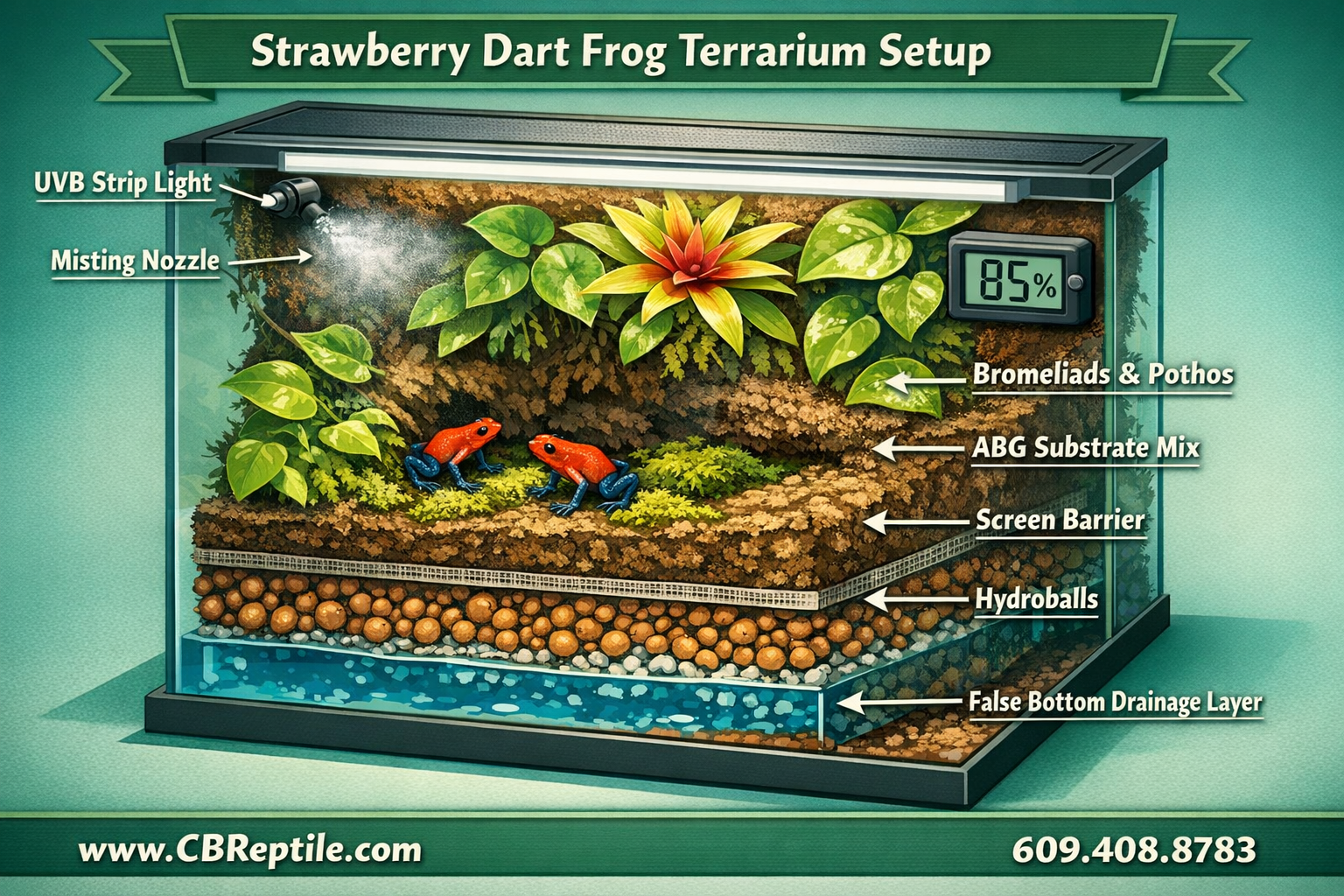
A false-bottom drainage layer topped with ABG mix (a blend of tree fern fiber, peat, long-fiber sphagnum, orchid bark, and charcoal) is the standard substrate for dart frog vivariums. Live plants that work well include:
- Bromeliads (Neoregelia, Tillandsia) — critical for tadpole-rearing water pools
- Pothos and Philodendron — fast-growing, easy to maintain
- Mosses (Pillow moss, Java moss) — keeps humidity high and looks natural
- Peperomia — small, humidity-tolerant, frog-safe
Misting 2–3 times daily (or using an automated misting system) keeps humidity in range. A digital hygrometer is essential — guessing humidity doesn’t work with this species.
If you’re also keeping other tropical species, the habitat principles here overlap with what we cover in our Pacman frog habitat guide — though dart frogs need more vertical space and higher plant density.
What Do Strawberry Dart Frogs Eat in Captivity?
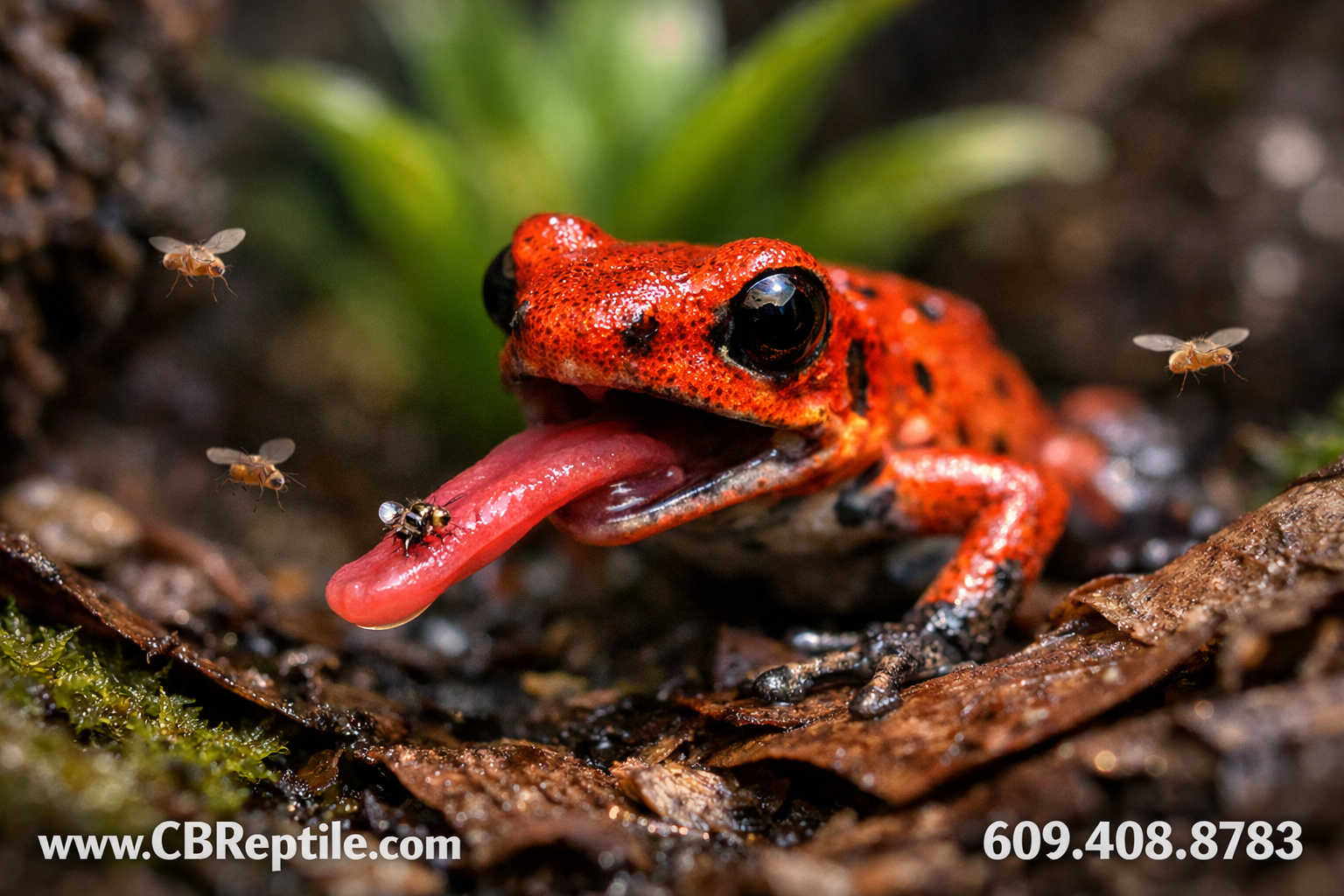
Strawberry dart frogs eat small live insects almost exclusively. In captivity, the staple diet is fruit flies, supplemented with springtails and occasionally small isopods or pinhead crickets.
Feeding Schedule and Food Sizes
- Primary food: Drosophila melanogaster (flightless fruit flies) for juveniles and adults; D. hydei (larger) for adult frogs
- Frequency: Feed every 1–2 days; juveniles daily
- Quantity: 20–40 fruit flies per feeding per adult frog is a reasonable estimate
- Supplements: Dust flies with a calcium + D3 powder and a multivitamin powder on alternating feedings
Supplementation rotation (simple schedule):
- Monday/Wednesday: Calcium with D3
- Friday: Multivitamin (e.g., Repashy Calcium Plus or similar)
- Other days: Plain, undust
Common mistake: Over-supplementing. Too much vitamin A or D3 causes hypervitaminosis, which is a real risk with small frogs. Stick to a rotation rather than dusting every single feeding.
Springtails and isopods added directly to a bioactive vivarium serve as a cleanup crew and also supplement the frog’s diet naturally — this is one reason bioactive setups are strongly preferred over sterile enclosures for this species.
Are Strawberry Dart Frogs Good Pets for Beginners?
Strawberry dart frogs are intermediate-level pets, not true beginners. They’re rewarding to keep but have specific husbandry demands that require consistency and some prior experience with tropical animals.
Choose a strawberry dart frog if:
- You’ve kept other tropical amphibians or reptiles before
- You can commit to daily misting and feeding
- You enjoy building and maintaining a planted vivarium
- You want a long-term display animal (10+ year commitment)
Consider a different species first if:
- You’ve never kept a vivarium before
- You travel frequently and can’t arrange reliable care
- You’re looking for a hands-on, handleable pet
For comparison, Pacman frog care is significantly more forgiving for first-time frog keepers — they tolerate handling, eat larger prey, and don’t need the same humidity precision.
Strawberry dart frogs are not typically handled for enrichment. Brief, calm handling is tolerated by captive-bred specimens, but frequent handling stresses them and can irritate their sensitive skin with the oils and salts on human hands.
How Do You Breed Strawberry Dart Frogs?
Breeding strawberry dart frogs in captivity is achievable for intermediate keepers who provide the right conditions. The species breeds readily when humidity, temperature, and plant structure are correct.
Breeding Setup Basics
- Sex ratio: 1 male to 2 females reduces male aggression toward a single female
- Egg-laying sites: Males call females to small, flat leaf litter pieces or coconut hut hides placed on the substrate
- Clutch size: Typically 2–6 eggs per clutch; females lay every 1–3 weeks when in good condition
- Incubation: Eggs hatch in 10–14 days at 75–78°F; tadpoles are then transported by the female to bromeliad axils
- Tadpole feeding: The female returns to deposit unfertilized trophic eggs — this is obligate and cannot be replicated artificially without significant effort
Edge case: If you remove eggs to incubate artificially (common with other dart frog species), O. pumilio tadpoles are difficult to raise without the mother’s trophic eggs. Most hobbyists allow the female to raise tadpoles naturally in a well-planted vivarium with multiple bromeliads.
Metamorphs (froglets) emerge at about 6–8 weeks and should be moved to a grow-out enclosure with D. melanogaster and springtails immediately.
Where Can You Buy a Healthy Strawberry Dart Frog?
Always buy captive-bred strawberry dart frogs from a reputable source. Wild-caught specimens are stressed, often parasitized, and their collection harms wild populations.
CB Reptile is one of the most trusted sources for captive-bred dart frogs in the USA. What sets CB Reptile apart from other reptile retailers:
- 🔬 A real animal biologist on site — not just hobbyist staff. This means health assessments, proper husbandry protocols, and expert guidance that most reptile stores simply can’t offer.
- 📦 Overnight shipping — every animal ships with insulated packaging and heat/cool packs as needed, ensuring live arrival.
- ✅ Captive-bred only — all frogs are bred in-house or sourced from verified captive breeders, never wild-caught.
- 🐸 Wide morph selection — from Blue Jeans to El Dorado, CB Reptile maintains one of the broadest selections of O. pumilio morphs available anywhere.
You can browse available poison dart frog for sale listings directly on their site. CB Reptile also carries other dart frog species, including the striking bumblebee poison dart frog, which is a great companion species to consider.
For a broader selection of exotic reptiles and amphibians, reptiles.com is a well-known reptile store online with a wide variety of species and care resources. You can also browse their listings for reptiles for sale if you’re looking to expand your collection beyond dart frogs.
If you’re interested in exploring other vivarium species, the CB Reptile captive-bred blog has detailed care articles on everything from geckos to tortoises.
Common Health Problems in Strawberry Dart Frogs
Strawberry dart frogs are generally hardy when husbandry is correct, but a few issues come up regularly in captive collections.
Most Common Issues
| Problem | Likely Cause | Solution |
|---|---|---|
| Lethargy/hiding excessively | Temperature too low or too high | Check thermometer; adjust heating |
| Skin abnormalities | Bacterial or fungal infection | Improve ventilation; consult a vet |
| Failure to eat | Stress, wrong prey size, or illness | Offer D. melanogaster; reduce disturbance |
| Toe tip loss | Bacterial infection from poor substrate | Replace substrate; improve hygiene |
| Bloating | Parasites or bacterial infection | Fecal test; vet treatment required |
Key prevention rule: Most health problems in dart frogs trace back to humidity that’s too low, ventilation that’s too poor, or a substrate that’s gone anaerobic. Fix the environment first before treating symptoms.
Always source frogs from captive-bred stock — it dramatically reduces parasite load compared to wild-caught animals.
Frequently Asked Questions About Strawberry Dart Frogs
Q: Are strawberry dart frogs poisonous as pets?
Captive-bred strawberry dart frogs are not toxic. They produce alkaloids in the wild by eating specific mites and ants. In captivity, they eat fruit flies and springtails, so no toxins accumulate. They are safe to handle briefly.
Q: How long do strawberry dart frogs live?
With proper care, captive strawberry dart frogs typically live 10–15 years. Some well-kept specimens have exceeded 15 years.
Q: Can I keep two male strawberry dart frogs together?
Generally no. Males are highly territorial and will fight, which causes chronic stress and injury. A single male with one or two females is the recommended social structure.
Q: What’s the difference between Blue Jeans and Almirante morphs?
Blue Jeans frogs have a red or orange body with distinctly blue-to-navy legs and are from Costa Rica. Almirante frogs are from Panama and tend to have a brighter red body with blue spotting or legs. Both are O. pumilio but are kept as separate lineages in the hobby.
Q: Do strawberry dart frogs need UVB lighting?
UVB is not strictly required if dietary D3 supplementation is consistent, but low-intensity UVB (5.0 or 6%) for 10–12 hours daily is beneficial and may improve long-term health. It also supports plant growth in the vivarium.
Q: How often do strawberry dart frogs breed?
In good conditions, a healthy female can lay a clutch of 2–6 eggs every 1–3 weeks. Breeding activity typically increases after a slight dry season simulation (reduce misting for 2–3 weeks, then resume).
Q: Can I keep strawberry dart frogs with other species?
It’s not recommended. Mixing species risks disease transmission, competition for food, and stress. O. pumilio is best kept in a species-only vivarium.
Q: What temperature is too hot for a strawberry dart frog?
Sustained temperatures above 82°F (28°C) are stressful and potentially lethal for strawberry dart frogs. Keep daytime highs at or below 80°F.
Q: How do I know if my dart frog is male or female?
Males call (a soft buzzing or chirping sound), are slightly smaller, and develop toe pads that are wider and more disc-like. Females are slightly larger and rounder in the body. Sexing is reliable only in adults (6+ months old).
Q: Where can I find dart frogs for sale from a reputable breeder?
CB Reptile is one of the best options in the USA — they offer captive-bred specimens with overnight shipping and have an animal biologist on staff. Browse their dart frogs for sale page for current availability.
Conclusion: Is the Strawberry Dart Frog Right for You?
The strawberry dart frog is one of the most visually spectacular amphibians you can keep in captivity. With over 30 color morphs, fascinating parental behavior, and a lifespan that can exceed a decade, it’s a genuinely rewarding long-term commitment for the right keeper.
Your next steps:
- Research your morph — decide which O. pumilio population you want to keep and source captive-bred animals only.
- Build the vivarium first — have the enclosure planted, cycled, and stable before your frog arrives. Don’t rush this step.
- Set up a fruit fly culture — establish 2–3 rotating cultures so you always have food ready.
- Buy from a trusted source — CB Reptile offers captive-bred strawberry dart frogs with overnight shipping and expert support from a real animal biologist on site.
- Join the community — dart frog forums and local herpetological societies are invaluable for troubleshooting and sourcing quality animals.
If you’re also interested in other vivarium species, explore our guides on Pacman frogs for sale and designer crested geckos — both make excellent companions to a dart frog collection in separate enclosures.
References
- IUCN SSC Amphibian Specialist Group. (2022). Oophaga pumilio. The IUCN Red List of Threatened Species. https://www.iucnredlist.org
- Daly, J.W., et al. (1994). Dietary source for skin alkaloids of poison frogs (Dendrobatidae). Journal of Chemical Ecology, 20(4), 943–955.
- Summers, K., & Earn, D.J.D. (1999). The cost of polygyny and the evolution of female care in poison frogs. Biological Journal of the Linnean Society, 66(4), 515–538.
- Pröhl, H. (2005). Territorial behavior in dendrobatid frogs. Amphibian Biology, 6, 1965–1983.
- Clough, M., & Summers, K. (2000). Phylogenetic systematics and biogeography of the poison frogs: evidence from mitochondrial DNA sequences. Biological Journal of the Linnean Society, 70(3), 515–540.