

Oustalet’s Chameleon Care Guide: Housing a Giant from Madagascar
Oustalet’s chameleon (Furcifer oustaleti) is one of the longest chameleons in the world and a true showpiece for experienced keepers. Native to Madagascar, it combines impressive size with a reputation for hardiness, adaptability and a big appetite. It is not a beginner’s first chameleon simply because of the space it needs, but for keepers ready to provide a large, well-ventilated enclosure it is a rewarding species to watch. You can learn more about the captive-bred Oustalet’s chameleon at www.CbReptile.com.
Natural History
Oustalet’s chameleon is found across much of Madagascar, from dry deciduous forest and scrub to humid forest edges, plantations and even village gardens. That wide range explains its adaptability: it tolerates warm days, cooler nights and seasonal changes in humidity better than many specialists. In the wild it spends most of its time in shrubs and trees, hunting insects and occasionally larger prey.
Appearance and Color
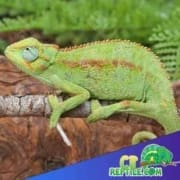
This is a long, laterally compressed chameleon with a low casque, a toothed dorsal crest and a long prehensile tail. Males are usually gray, brown or olive with lighter bands and can look almost prehistoric at full size. Females are smaller and often show more color, including green, rust, orange or pink tones, especially when gravid or responding to a male. Like all chameleons, color shifts with temperature, mood and light, so learning your animal’s relaxed coloring helps you spot stress early.

Size and Lifespan
Adult males commonly reach 20 inches or more in total length, and exceptional animals approach 27 inches. Females are noticeably smaller, often in the 12 to 16 inch range. With good husbandry a lifespan of roughly five to eight years is a reasonable expectation, with females generally shorter-lived because of the demands of egg production. Females can lay large clutches even without a male, so a proper lay bin and strong calcium support are essential.
Temperament
Oustalet’s chameleons are bold and often less shy than smaller species, but they are still solitary display animals. Some individuals become calm with a steady routine, while others puff, hiss or gape when approached. Always house them alone, keep other chameleons out of view, and avoid placing the enclosure in a busy walkway.
Enclosure
Size is the defining part of Oustalet’s chameleon care. A juvenile can start in a 24 x 24 x 48 inch screen enclosure, but an adult male needs considerably more room, ideally 36 x 36 x 72 inches or a custom setup. Screen or hybrid enclosures such as the ReptiBreeze chameleon cage provide the airflow chameleons need. Inside, provide:

- Sturdy horizontal and diagonal branches thick enough for a large animal to grip
- Dense live plants such as pothos, ficus or schefflera for cover and drinking droplets
- Open basking perches near the top, away from direct contact with the lamp
- A deep, moist lay bin for adult females, offered when digging behavior appears
Heat, UVB and Humidity
Offer a basking spot of about 85 to 95°F for adults, with the rest of the enclosure in the mid 70s to low 80s°F. Nights can safely fall into the 60s°F. Use a thermostat or dimmer on the heat lamp and check temperatures at perch level.
A linear T5 HO UVB tube, such as the Reptisun 10.0 T5 HO, mounted across the top of the enclosure supports calcium metabolism; follow the manufacturer’s distance guidance and replace tubes on schedule. Keep humidity around 50 to 70 percent, mist two or three times daily until leaves drip, and add a dripper. Chameleons rarely drink from bowls, so moving water is important.
Diet
Oustalet’s chameleons are hearty eaters. Rotate crickets, dubia roaches, black soldier fly larvae, silkworms, superworms and hornworms, sized no longer than the space between the eyes. Gut-load insects 24 hours before feeding, dust with calcium most meals, and use a multivitamin once or twice a month. Juveniles eat daily; adult males do well every other day, and females need careful portioning to avoid overly large clutches.

Handling
Limit handling to necessary moves and health checks. Let the chameleon walk onto your hand from below rather than grabbing from above, and never pull it off a branch while it is gripping. Short, calm sessions help a bold individual tolerate routine care.
Why Captive-Bred Matters
Captive-bred chameleons arrive free of the heavy parasite loads and shipping stress common in wild-caught animals, and they are already used to captive feeders and misting routines. Supporting captive breeding also reduces pressure on wild Madagascar populations. Keepers who enjoy large species may also like the rainbow Jackson’s chameleon, which suits cooler setups.
Oustalet’s Chameleon Care FAQ
How big does an Oustalet’s chameleon get?
Males often exceed 20 inches including the tail and can approach 27 inches, while females are smaller.
Is an Oustalet’s chameleon good for beginners?
It is hardy, but its size and space needs make it better for keepers with some chameleon experience.
Do Oustalet’s chameleons need UVB?
Yes. A quality T5 HO UVB tube is essential for bone health and calcium use.
How often should I mist?
Two or three times daily, plus a dripper, keeps humidity in range and gives the chameleon water to drink.
Meet our captive-bred Oustalet’s chameleons at www.CbReptile.com and plan a spacious, airy home for one of Madagascar’s giants.

Leave a Reply
Want to join the discussion?Feel free to contribute!