
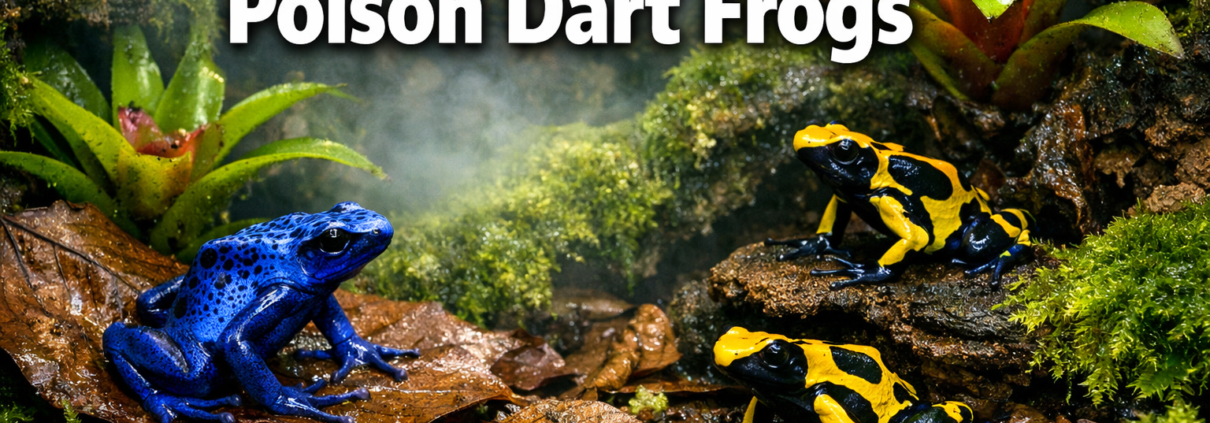
Breeding Poison Dart Frogs
Quick Facts: Breeding poison dart frogs in captivity is achievable for dedicated hobbyists who replicate tropical conditions — consistent temperatures of 72–78°F, high humidity (80–100%), a bioactive vivarium with live plants, and species-appropriate pairing. Eggs are laid on broad leaves or in film canisters, tadpoles are raised individually in small water containers, and froglets are ready to transition to a grow-out enclosure within 60–90 days of hatching.
- Display 9 Products per page
Key Takeaways 🐸
- Breeding poison dart frogs requires stable tropical conditions, not advanced herpetology degrees — patience and consistency matter most.
- Choose a proven breeding species first: Dendrobates tinctorius, Oophaga pumilio, or Ranitomeya imitator are popular starting points.
- A bioactive vivarium with live plants, cork bark hides, and film canister egg-laying sites dramatically increases breeding success.
- Eggs hatch in 10–16 days; tadpoles must be raised separately to prevent cannibalism in most species.
- Captive-bred dart frogs are NOT toxic — their wild toxicity comes from a specialized diet of wild arthropods unavailable in captivity.
- CB Reptile has a real animal biologist on site, unlike most reptile stores, ensuring the frogs you receive are healthy, well-conditioned, and ready to breed.
- Seasonal “rain cycles” triggered by increased misting often stimulate breeding behavior in reluctant pairs.
- Fruit flies (Drosophila melanogaster and D. hydei) dusted with vitamin and calcium supplements are the core feeder insect for all life stages.
- Froglets should not be housed with adult frogs until they reach near-adult size.
- Captive breeding supports conservation by reducing demand for wild-caught specimens.
What Do You Need Before Breeding Poison Dart Frogs?
Before you attempt breeding poison dart frogs, you need a stable, mature vivarium and a confirmed opposite-sex pair. Rushing this step is the single most common reason breeding attempts fail.
Vivarium Setup Essentials
A bioactive vivarium is not optional for serious breeding — it provides the microclimate stability and behavioral triggers that dart frogs need to reproduce. Here’s what a functional breeding enclosure requires:
| Parameter | Target Range | Notes |
|---|---|---|
| Temperature | 72–78°F (22–25°C) | Avoid spikes above 82°F |
| Humidity | 80–100% | Mist 2–3x daily or use auto-mister |
| Enclosure Size | 18x18x24″ minimum per pair | Taller for arboreal species |
| Lighting | 10–12 hours per day | Full-spectrum LED or T5 UVB |
| Substrate | ABG mix or similar | 3–4 inches deep for drainage |
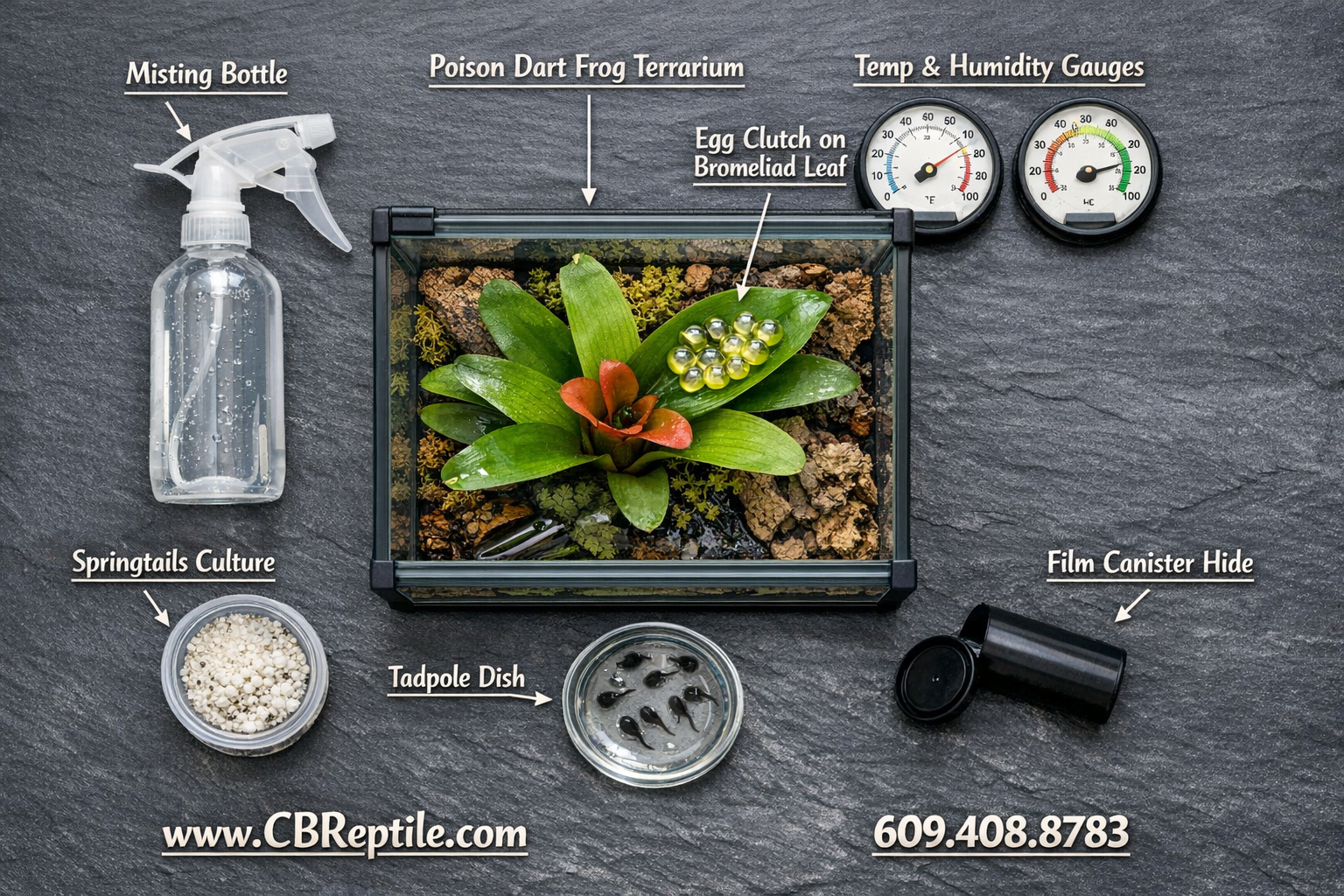
Live plants are not decorative — they’re functional. Bromeliads collect water pools that arboreal species use for tadpole deposition. Broad-leafed plants like Philodendron and Pothos serve as egg-laying surfaces. Cork bark tubes and film canisters provide secure hides where pairs will court and deposit eggs.
“A well-planted vivarium does half the work of breeding for you. The frogs feel secure, humidity stays stable, and natural behaviors emerge on their own schedule.”
A reptile misting system is one of the best investments you can make for a dart frog breeding setup — automated misting removes the guesswork from humidity management.
How Do You Sex Poison Dart Frogs for Breeding?
Accurate sexing is essential for breeding poison dart frogs, and it’s harder than it looks in juveniles. Most species cannot be reliably sexed until 8–12 months of age.
Key sexing indicators by species:
- Dendrobates tinctorius: Males have wider toe pads and a more flattened body profile; females are generally larger and more rounded.
- Oophaga pumilio (Strawberry dart frog): Males call frequently; females are slightly plumper when gravid.
- Ranitomeya species: Males are slimmer; females develop a rounder abdomen when carrying eggs.
- Phyllobates terribilis: Males call and display; females are noticeably larger.
Common mistake: Buying two frogs from the same clutch at the same age and assuming you have a pair. Always purchase frogs from a reputable source that can confirm sex. CB Reptile’s on-site animal biologist sexes animals before sale — a real advantage over stores that simply guess.
For poison dart frogs for sale that are already confirmed as breeding-age animals, sourcing from a specialist breeder saves months of uncertainty.
What Are the Best Species for Breeding Poison Dart Frogs?
Not all dart frog species are equally beginner-friendly for captive breeding. The best species for new breeders are those with straightforward husbandry, reliable breeding triggers, and manageable clutch sizes.
Top Species Ranked for Breeding Ease
1. Dendrobates tinctorius (Dyeing Dart Frog)
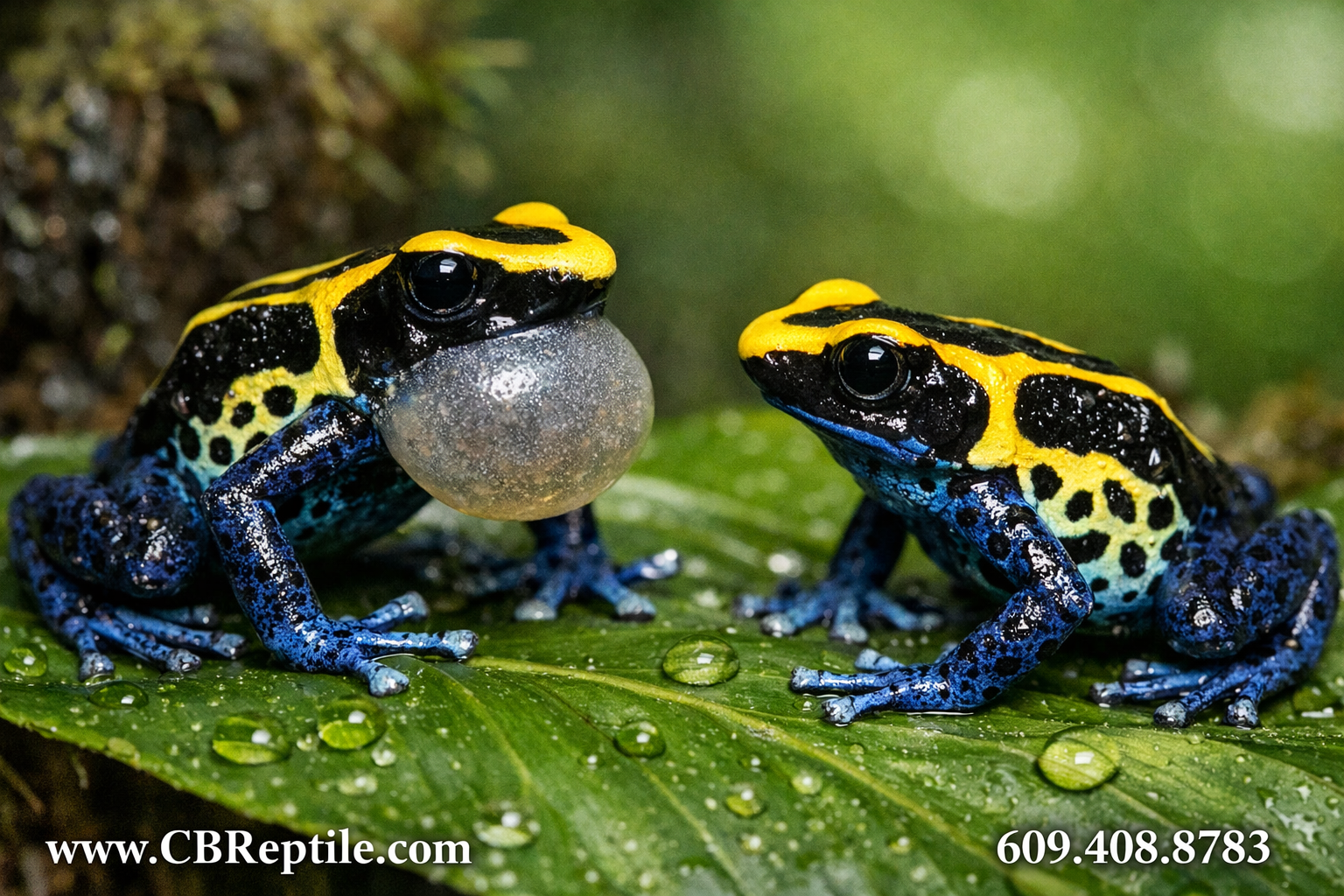
The most popular captive-bred dart frog in the USA. Clutches of 4–6 eggs are laid on broad leaves or in film canisters. Tadpoles are raised individually in small deli cups. Color morphs include Azureus (blue), Patricia, Powder Blue, Cobalt, and many more.
2. Oophaga pumilio (Strawberry Dart Frog)
Obligate egg-feeders — females return to feed unfertilized eggs to tadpoles, making them more demanding to breed but incredibly rewarding. The “Bastimentos” and “Almirante” morphs are especially sought after.
3. Ranitomeya imitator
Smaller frogs with stunning mimicry-based color patterns. Pairs bond closely and are often kept as true pairs rather than groups. Tadpoles are transported to bromeliads by the male.
4. Phyllobates terribilis (Golden Poison Frog)
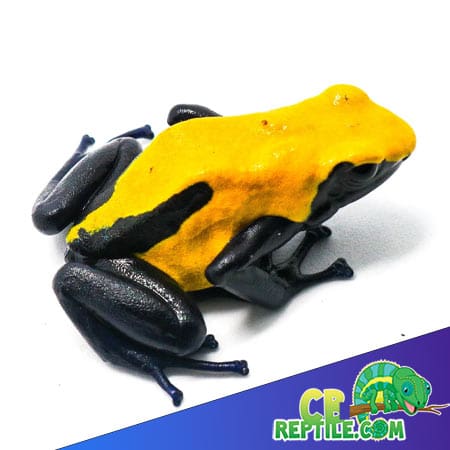
The largest dart frog commonly kept in captivity. Relatively easy to breed in groups; males call loudly during breeding season. Available in orange, yellow, and mint color morphs.
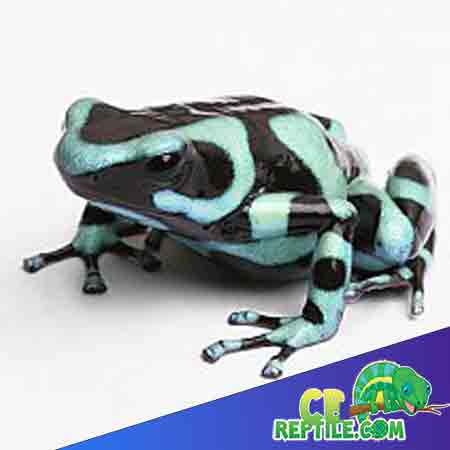
5. Dendrobates auratus (Green and Black Dart Frog)
Hardy, adaptable, and reliably bred in captivity. A great first species for breeders new to the genus.
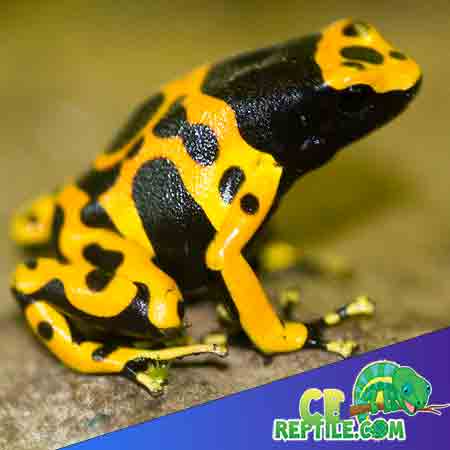
You can browse the bumblebee poison dart frog as one example of the striking color morphs available through CB Reptile.
How Does the Breeding Poison Dart Frogs Process Actually Work?
Breeding poison dart frogs follows a predictable sequence once environmental conditions are right. Understanding each stage helps you intervene correctly — and know when to leave the frogs alone.
Step-by-Step Breeding Sequence
Step 1: Conditioning the pair (4–8 weeks)
Feed heavily with vitamin-dusted fruit flies twice daily. A well-fed female will visibly plump up as she develops eggs. Males begin calling more frequently.
Step 2: Trigger the rain cycle
Increase misting frequency for 1–2 weeks, then reduce slightly. This mimics the onset of tropical rainy season and often triggers courtship within days.
Step 3: Courtship behavior
The male leads the female to a chosen egg-laying site — usually a film canister, broad leaf, or bromeliad axil. Courtship can last hours or days. Do not disturb the pair during this stage.
Step 4: Egg deposition
The female deposits 4–10 eggs (species-dependent) on a moist surface. The male fertilizes them immediately. Eggs are small, clear-to-white, and arranged in a tight cluster.
Step 5: Egg incubation (10–16 days)
Leave eggs in the vivarium if the parents are reliable transporters (as in Ranitomeya species). For Dendrobates species, many breeders remove the egg-laying site to a separate incubation container with a moist paper towel, kept at 74–76°F.
Step 6: Tadpole transport and individual rearing
Once hatched, tadpoles are moved to individual 16 oz deli cups with aged, dechlorinated water. Change 50% of the water every 3–4 days. Feed with spirulina powder, fish flakes, or commercial tadpole food.
Step 7: Metamorphosis (45–90 days)
Tadpoles develop legs, then reabsorb their tails. Once the tail is fully absorbed, move froglets to a grow-out enclosure. Do not house froglets with adults.
What Do You Feed Breeding Poison Dart Frogs?
Nutrition directly drives breeding success. A poorly fed female will not develop viable eggs, and calcium-deficient frogs are prone to metabolic bone disease.
Core feeder insects:
- Drosophila melanogaster (small fruit flies) — ideal for juveniles and smaller species like Ranitomeya
- Drosophila hydei (large fruit flies) — better for adult Dendrobates tinctorius and Phyllobates
- Springtails (Collembola) — excellent supplemental feeders and vivarium cleaners
- Isopods (small species like Trichorhina tomentosa) — secondary protein source
Supplementation schedule:
| Supplement | Frequency | Purpose |
|---|---|---|
| Calcium (no D3) | Every feeding | Bone health, egg production |
| Calcium + D3 | 2x per week | D3 balance under artificial lighting |
| Multivitamin | 1x per week | Overall health, color vibrancy |
Critical rule: Always dust feeders immediately before offering them — supplements fall off quickly. Underdosing calcium is a leading cause of failed clutches and soft-shelled eggs.
How Do You Raise Poison Dart Frog Tadpoles Successfully?
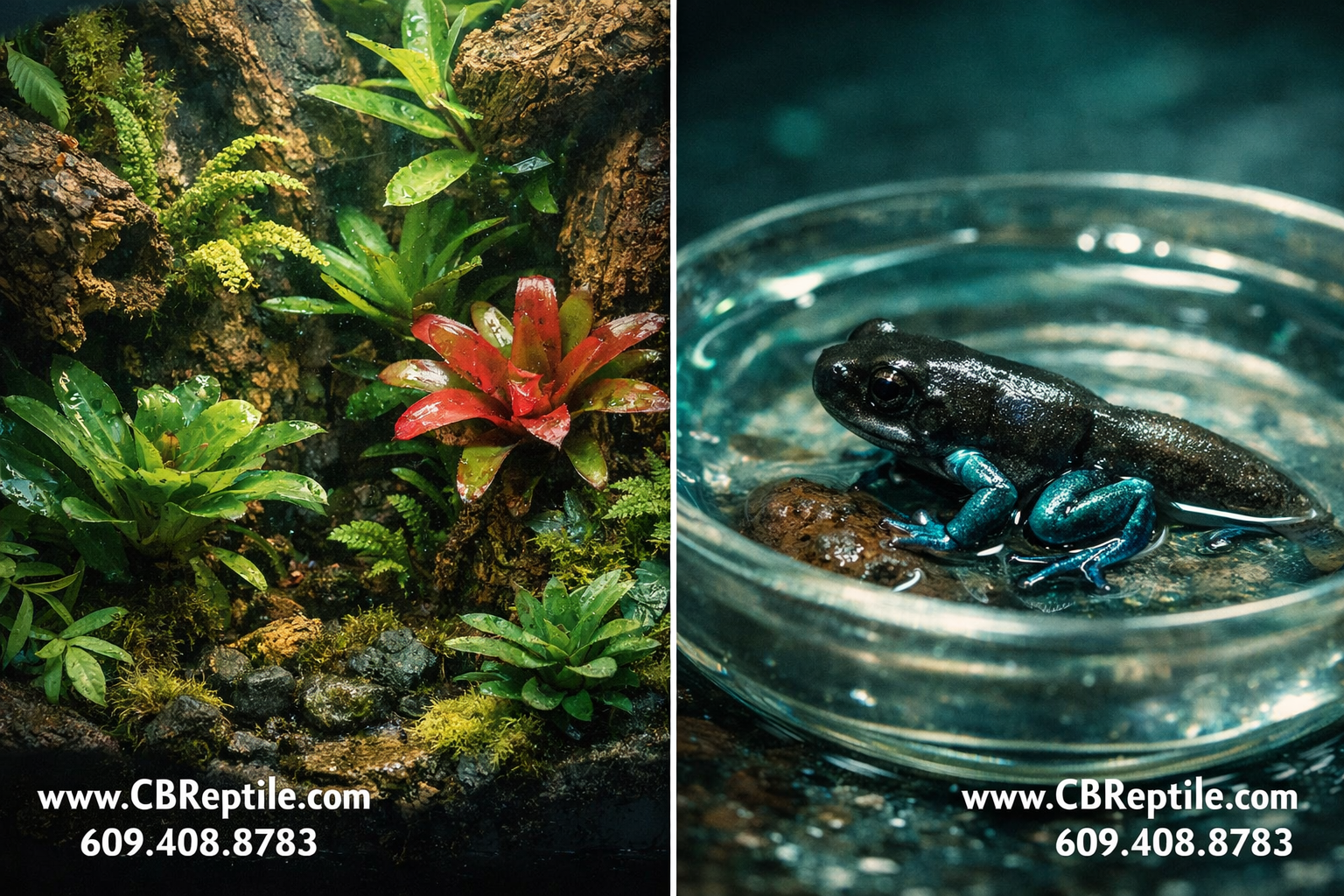
Raising tadpoles is where many first-time breeders lose animals. The key rules are individual housing, clean water, and consistent temperature.
Tadpole Care Checklist ✅
- House each tadpole in a separate 16 oz deli cup or small container
- Use aged, dechlorinated water (let tap water sit 24 hours, or use RO water)
- Maintain water temperature at 74–76°F
- Change 50% of water every 3–4 days
- Feed small amounts of spirulina powder or crushed fish flakes every other day
- Keep containers in a warm, dark location — avoid direct light on water
- Once front legs emerge, add a small piece of cork bark or foam so the froglet can climb out of the water
- Move fully metamorphosed froglets to a moist grow-out enclosure immediately
Edge case: Oophaga pumilio tadpoles require the mother to return and deposit unfertilized “trophic eggs” as food. If you remove the tadpoles from the vivarium, you must manually feed them trophic eggs from the female or use a commercial substitute. This is why pumilio breeding is considered intermediate-to-advanced level.
What Are the Most Popular Color Morphs for Breeding?
One of the biggest draws of breeding poison dart frogs is the extraordinary color diversity across morphs and locales. Each morph breeds true, meaning offspring reliably display the parent’s coloration.
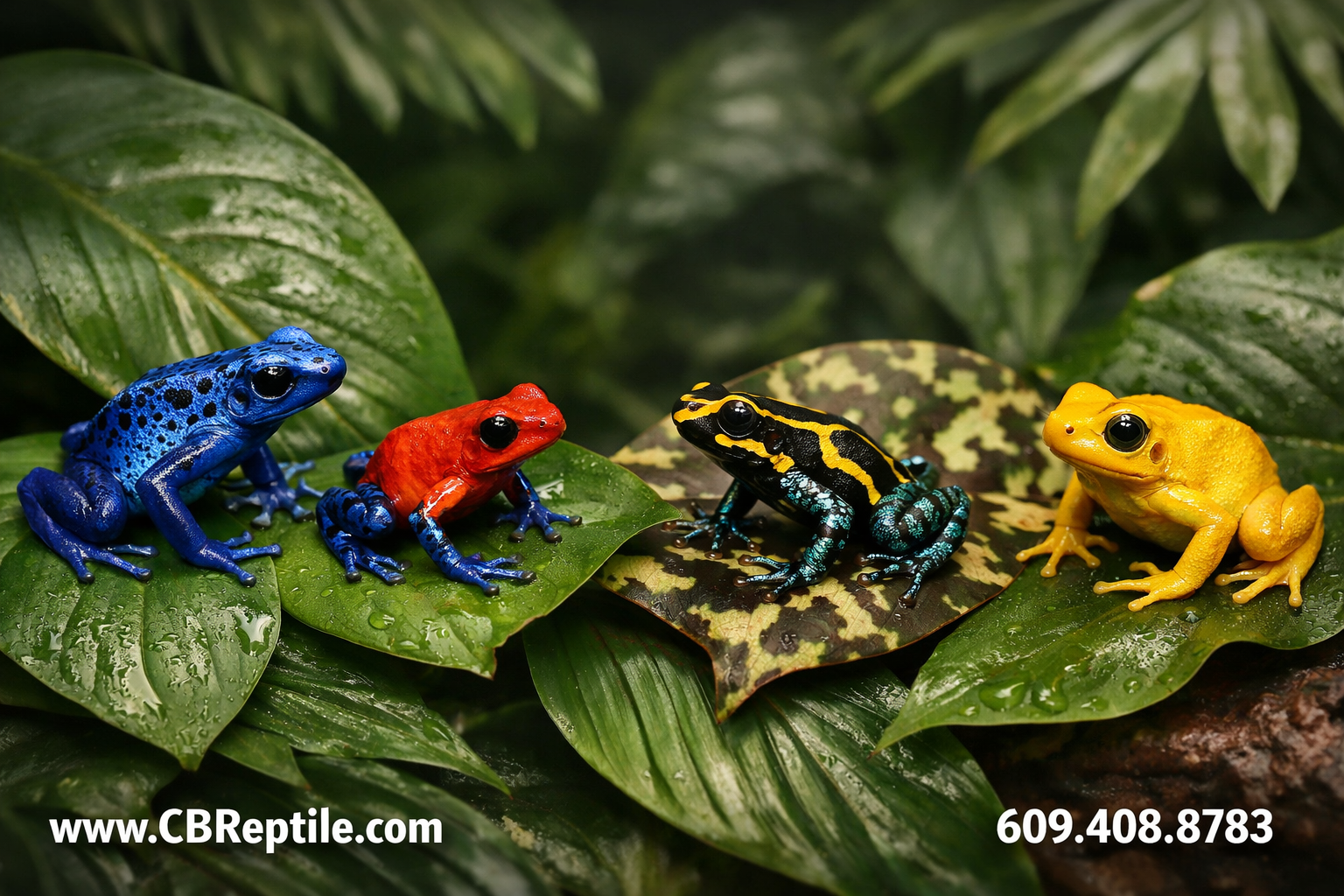
Popular Morphs by Species
Dendrobates tinctorius morphs:
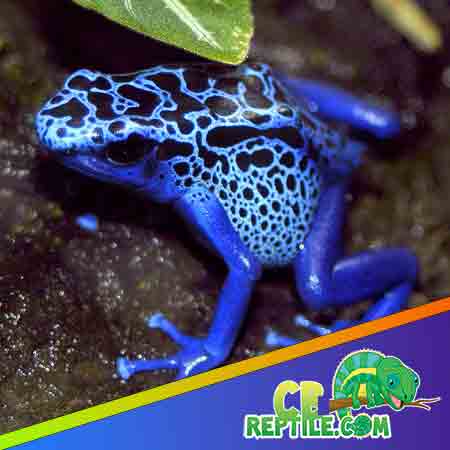
- Azureus — solid sky blue with black spots; the iconic “blue dart frog”
- Patricia — yellow and black, highly sought after
- Powder Blue — pale blue with black patterning
- Cobalt — deep cobalt blue, minimal spotting
- Citronella — yellow with reduced black patterning
- Bakhuis — orange and black, rarer in captivity
Oophaga pumilio morphs:
- Bastimentos — red with black spots
- Almirante — orange-red
- Blue Jeans — red body with blue legs (the classic “strawberry” look)
- Bocas — highly variable, population-specific
Phyllobates terribilis morphs:
- Orange — the most common captive form
- Yellow — bright lemon yellow
- Mint — pale green, rarest of the three
Ranitomeya imitator morphs:
- Varadero — stunning blue and black
- Tarapoto — orange and black striped
- Chazuta — yellow striped
CB Reptile is your source for the best quality, healthiest dart frogs for sale in the USA, with captive-bred animals across many of these popular morphs available year-round.
What Are Common Mistakes When Breeding Poison Dart Frogs?
Even experienced keepers make these errors. Knowing them in advance saves animals and frustration.
1. Pairing incompatible species
Never house different dart frog species together. Cross-species breeding produces infertile eggs and causes stress. Dendrobates and Oophaga should never share an enclosure.
2. Ignoring temperature spikes
Temperatures above 82°F are dangerous and can kill eggs, tadpoles, and adults. Use a digital thermometer with min/max memory to catch overnight or daytime spikes.
3. Overcrowding
More frogs does not mean more breeding. A single proven pair in a well-planted 18x18x24″ enclosure outproduces four frogs crammed into the same space. Stress suppresses reproduction.
4. Removing eggs too early
Wait until eggs are clearly developing (you’ll see a small dark mass forming inside) before moving them. Handling undeveloped eggs increases failure rates.
5. Skipping supplementation
Fruit flies alone are nutritionally incomplete. Without consistent calcium and vitamin dusting, females stop producing viable eggs within weeks.
If you’re also interested in breeding other reptiles and amphibians, our guides on breeding leopard geckos and panther chameleon breeding cover similar principles of conditioning and environmental triggers.
FAQ: Breeding Poison Dart Frogs
Q: How old do poison dart frogs need to be before breeding?
Most species reach sexual maturity at 12–18 months of age. Breeding younger animals risks health complications and poor egg viability.
Q: How many eggs does a poison dart frog lay per clutch?
Clutch size varies by species. Dendrobates tinctorius typically lays 4–6 eggs; Phyllobates terribilis may lay up to 20. Most species breed multiple times per year under good conditions.
Q: Can I breed dart frogs in a group?
Some species like Dendrobates tinctorius and Phyllobates terribilis can be kept and bred in groups of 1.2 or 1.3 (one male, two or three females). Others like Ranitomeya imitator form monogamous pairs and do best as true pairs.
Q: Are captive-bred dart frogs toxic?
No. Captive-bred dart frogs are non-toxic. Their wild toxicity comes from sequestering alkaloids from specialized wild arthropods not present in captive diets.
Q: How do I know if my dart frog eggs are fertile?
Fertile eggs will show a dark embryo forming within 3–5 days. Infertile eggs turn white or opaque and often develop mold. Remove moldy eggs promptly to protect healthy ones.
Q: What water should I use for tadpoles?
Use reverse osmosis (RO) water or aged tap water with a dechlorinator. Avoid distilled water, which lacks trace minerals. Target a pH of 6.5–7.0.
Q: How long does it take for tadpoles to metamorphose?
Most dart frog tadpoles complete metamorphosis in 45–90 days depending on species, temperature, and feeding. Dendrobates tinctorius tadpoles typically take 60–75 days.
Q: Can I house froglets with adult frogs?
No. Adults will outcompete froglets for food and may injure them. Keep froglets in a separate grow-out enclosure until they approach adult size (usually 4–6 months post-metamorphosis).
Q: Where can I buy captive-bred poison dart frogs?
CB Reptile offers poison dart frog for sale listings with overnight shipping and a live arrival guarantee. Their on-site animal biologist ensures every animal is healthy before it ships. You can also browse a wider selection of reptiles for sale and find a trusted reptile store online for comparison.
Q: Do dart frogs need UVB lighting?
Current evidence suggests dart frogs benefit from low-level UVB exposure (2.0 or 5.0 bulbs), especially when breeding. It supports D3 synthesis and may improve egg viability.
Q: How often will a healthy pair breed?
Under optimal conditions, a conditioned pair of Dendrobates tinctorius may breed every 2–4 weeks. Breeding frequency slows if the female is not adequately fed between clutches.
Q: Is breeding poison dart frogs legal?
Captive breeding of most dart frog species is legal in the USA without permits. However, Dendrobates and related genera are CITES Appendix II listed, meaning commercial export from range countries is regulated. Always buy captive-bred animals from reputable domestic breeders.
Conclusion: Your Next Steps for Breeding Poison Dart Frogs
Breeding poison dart frogs is one of the most rewarding projects in the reptile and amphibian hobby. The process is methodical: build a stable bioactive vivarium, source a confirmed pair of a beginner-friendly species, feed consistently with supplemented fruit flies, and let the frogs do what they’re designed to do when conditions are right.
Actionable next steps:
- Choose your species based on experience level — start with Dendrobates tinctorius or Dendrobates auratus if you’re new to dart frogs.
- Build or buy a bioactive vivarium with live plants, proper drainage, and automated misting before you bring frogs home.
- Source captive-bred animals from a reputable breeder with biological expertise on staff — CB Reptile ships overnight with live arrival guarantees.
- Set up a supplementation routine before your frogs arrive so it becomes habit from day one.
- Document everything — note breeding dates, clutch sizes, and tadpole development. This data helps you refine your approach with every generation.
If you’re exploring other captive breeding projects alongside dart frogs, our guides on elongated tortoise breeding and Hermann’s tortoise breeding offer the same systematic approach applied to different species.
The dart frog hobby rewards patience and attention to detail. Get the fundamentals right, and you’ll be raising froglets within your first year.
References
- Lotters, S., Jungfer, K.H., Henkel, F.W., & Schmidt, W. (2007). Poison Frogs: Biology, Species & Captive Husbandry. Edition Chimaira.
- Schulte, R. (1999). Pfeilgiftfrösche: Artenteil. Natur und Tier Verlag.
- AmphibiaWeb. (2024). Dendrobatidae species accounts. University of California, Berkeley. https://amphibiaweb.org
- CITES. (2023). Appendix II species listings: Dendrobatidae. https://cites.org
- Caldwell, J.P. (1996). The evolution of myrmecophagy and its correlates in poison frogs (family Dendrobatidae). Journal of Zoology, 240(1), 75–101.