
Last updated: February 23, 2026
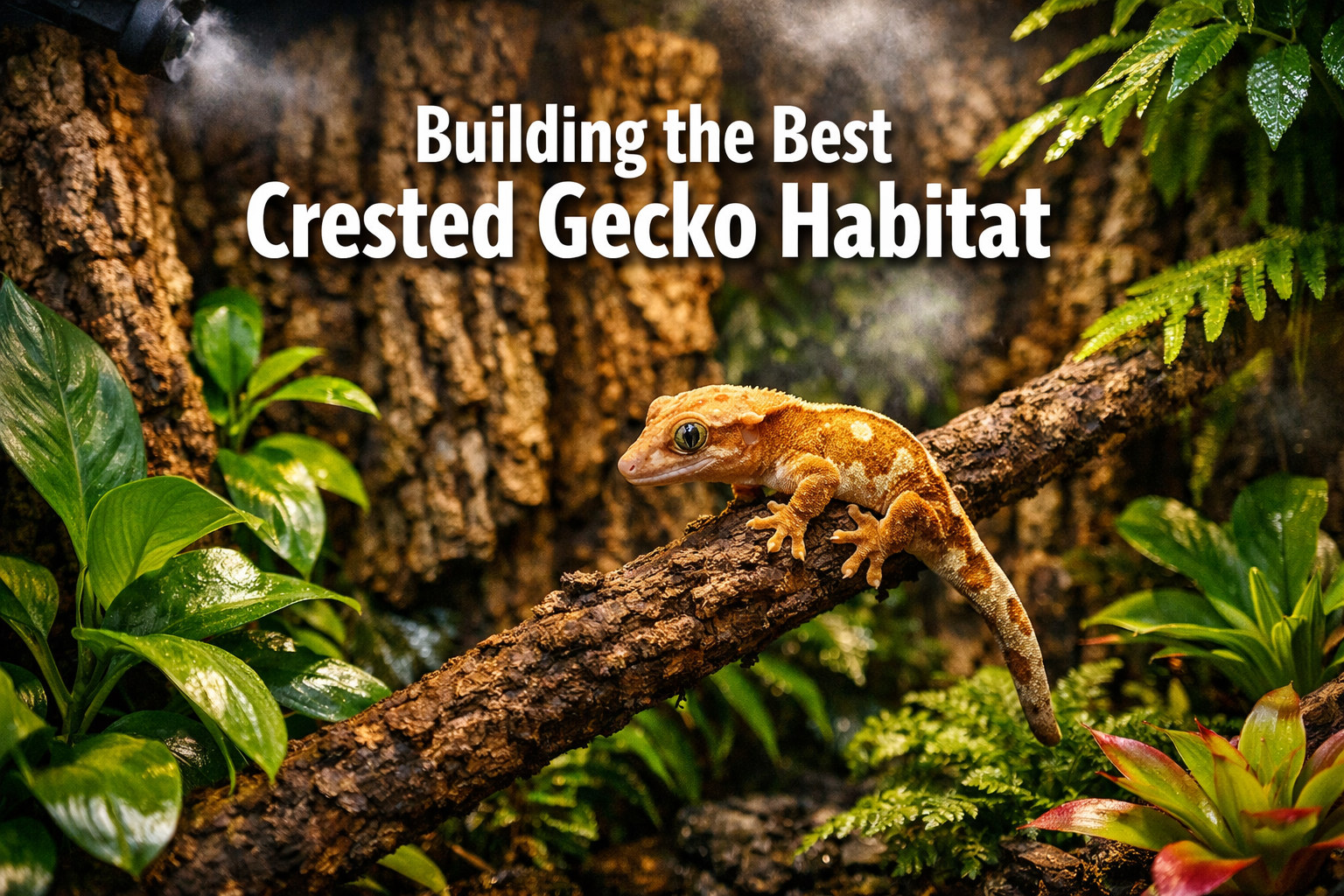
I’ve been keeping crested geckos for years, and I can tell you that building the best crested gecko habitat is the single most important decision you’ll make for your gecko’s health and happiness. A properly designed enclosure mimics the humid, vertical forests of New Caledonia where these arboreal geckos naturally thrive, providing the climbing space, humidity control, and environmental enrichment they need to display natural behaviors and live long, healthy lives.
Whether you’re bringing home your first crested gecko for sale or upgrading an existing setup, this guide will walk you through every aspect of creating an optimal habitat that keeps your gecko thriving for 15-20 years.
Key Takeaways
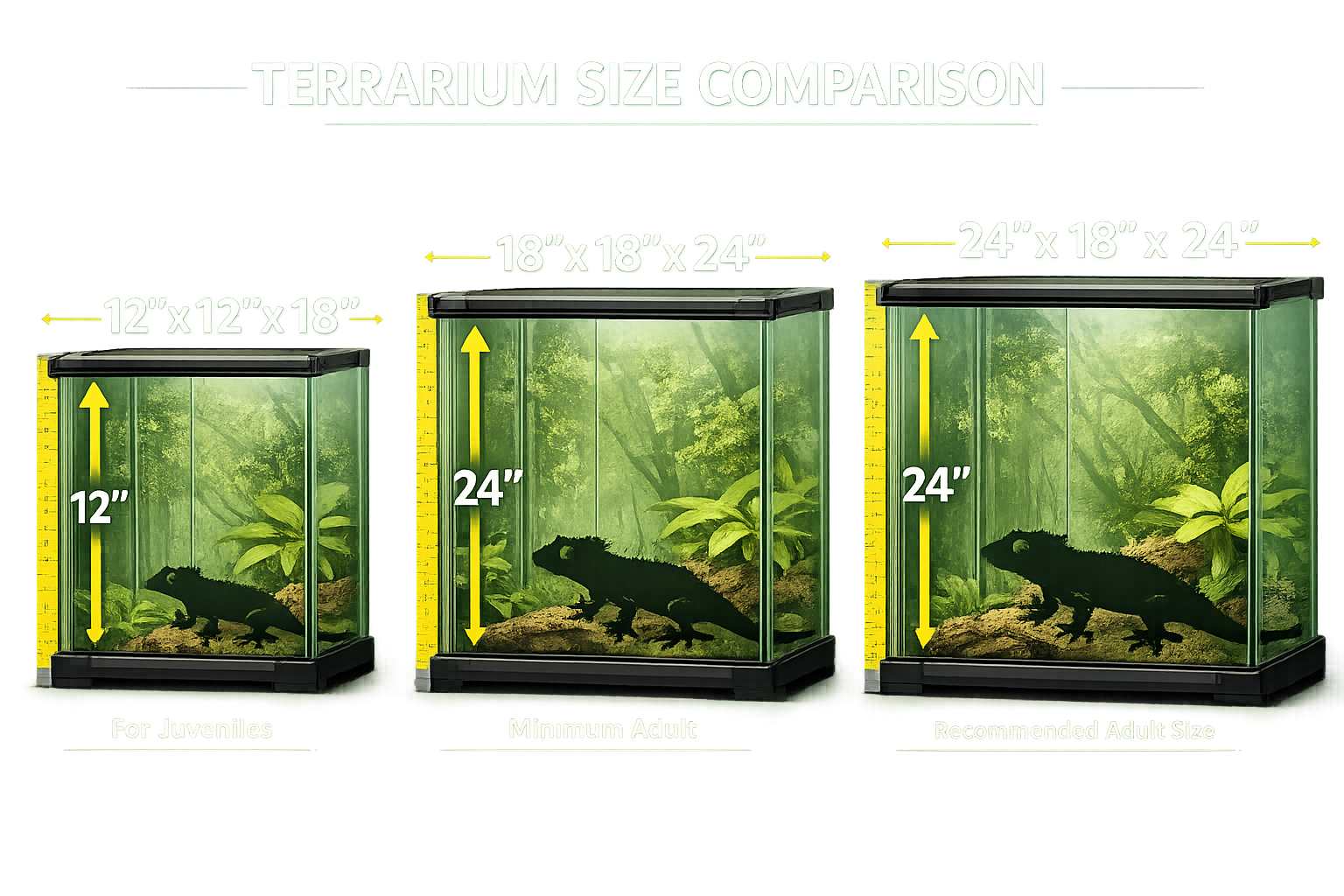
- Vertical space is critical: Adult crested geckos need minimum 18″x18″x24″ enclosures, with 24″x18″x24″ recommended for optimal health and activity
- Height matters more than floor space: These arboreal geckos spend 90% of their time in upper canopy areas and rarely touch the ground
- Bioactive substrates are superior: Organic soil bases with sphagnum moss, springtails, and isopods create self-sustaining ecosystems that maintain humidity and reduce maintenance
- Multiple climbing pathways are essential: Arrange branches at horizontal, diagonal, and vertical angles with at least one-third covered in bark or absorbent material
- Humidity control requires daily attention: Maintain 60-80% humidity with daily misting, allowing enclosures to dry between sessions to prevent bacterial growth
- Temperature stability is non-negotiable: Keep consistent 72-78°F range with regulated overhead heat sources rather than relying on room temperature alone
- Dense foliage reduces stress: Live or artificial plants are mandatory for providing security, hiding spots, and humidity retention through transpiration
- Strategic hide placement matters: Position 2-3 hides per gecko at upper, mid, and lower levels, with primary hides near the top for nighttime security
Quick Answer
Building the best crested gecko habitat requires a vertically-oriented glass terrarium (minimum 18″x18″x24″ for adults), moisture-retaining bioactive substrate, multiple climbing branches arranged at various angles, dense live or artificial foliage, and precise environmental controls maintaining 60-80% humidity and 72-78°F temperatures. The enclosure must prioritize vertical space over floor area, as crested geckos are arboreal species that spend most of their time in upper canopy areas rather than on the ground.
What Size Enclosure Do You Need for Building the Best Crested Gecko Habitat?
For adult crested geckos, the minimum enclosure size is 18″x18″x24″ (length x width x height), though 24″x18″x24″ provides significantly better quality of life and allows for more natural behaviors[1][2]. Baby and juvenile geckos require smaller starter enclosures of 12″x12″x18″ to prevent feeding difficulties and stress from excessive space.
The vertical dimension is far more important than floor space because crested geckos are arboreal species that rarely venture to ground level in their natural habitat[2]. In the wild, these geckos spend their entire lives in the forest canopy, moving between branches and foliage 10-30 feet above the forest floor.
Choosing the right size based on your gecko’s age:
- Hatchlings (0-3 months): 12″x12″x18″ prevents prey items from escaping and allows easier monitoring
- Juveniles (3-6 months): 12″x12″x18″ or upgrade to 18″x18″x24″ if feeding consistently
- Young adults (6-12 months): 18″x18″x24″ minimum as they become more active
- Full adults (12+ months): 24″x18″x24″ recommended for optimal enrichment and exercise
Common mistake: Many keepers house babies directly in adult-sized enclosures, which can cause feeding problems as crickets and other prey items hide too easily. Start small and upgrade as your gecko grows.
Glass terrariums with screened lids are essential for proper ventilation while maintaining humidity[1][2]. Avoid fully screened enclosures, as they cannot hold the 60-80% humidity levels crested geckos require.
For detailed specifications on enclosure requirements, check out our comprehensive crested gecko habitat setup guide.
Which Substrate Works Best When Building the Best Crested Gecko Habitat?
Bioactive substrates represent the gold standard for crested gecko enclosures, combining organic soil base, sphagnum moss, fine sand, springtails, and isopods to create self-sustaining ecosystems that manage waste and maintain humidity[2]. Terra Fauna substrate is widely considered the best commercial option, supplemented with biodegradable materials like sphagnum moss and leaf litter[1].
The substrate layer serves multiple critical functions: moisture retention, waste decomposition, beneficial bacteria cultivation, and providing a naturalistic appearance that reduces stress. A proper bioactive setup can last years with minimal maintenance beyond occasional top-dressing.
Best substrate options ranked by performance:
- Bioactive soil mix (Terra Fauna or DIY blend): Superior humidity retention, waste management, and natural ecosystem development
- Sphagnum moss: Excellent moisture maintenance, easy to spot-clean, prevents bacterial growth when changed regularly
- Coconut fiber (coco coir): Good moisture retention, affordable, but requires more frequent changing
- Cypress mulch: Decent humidity control, natural appearance, but can harbor mites if not properly maintained
Substrates to avoid completely:
- Reptile carpet (harbors bacteria, difficult to clean, snags toenails)
- Wood chips or shavings (poor humidity retention, ingestion risk)
- Sand alone (causes impaction if ingested)
- Newspaper or paper towels (cannot maintain proper humidity levels)
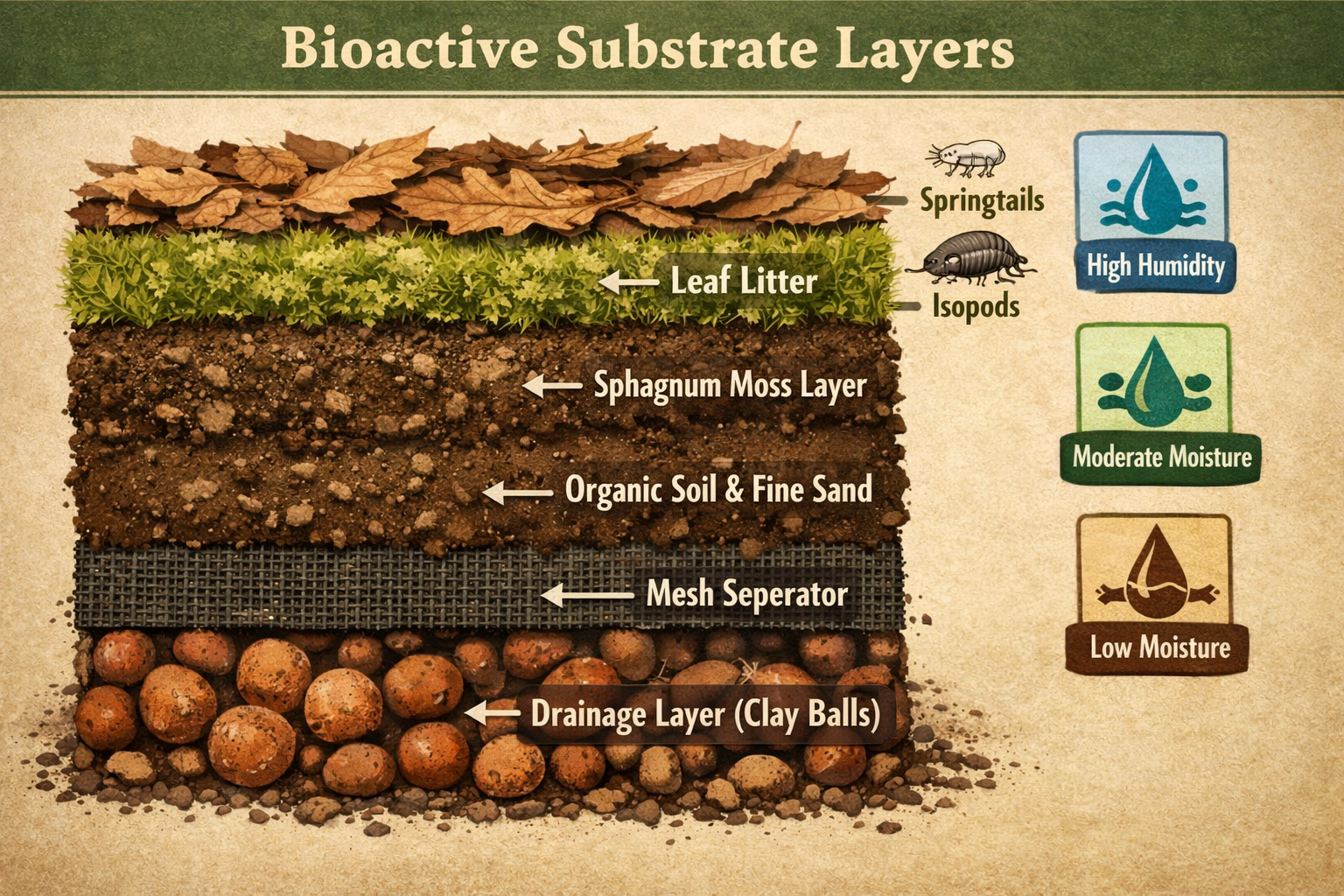
Building a bioactive substrate layer (bottom to top):
- Drainage layer: 1-2 inches of clay balls or large gravel
- Mesh separator: Prevents soil from mixing into drainage
- Soil base: 3-4 inches of organic potting soil mixed with fine sand (70/30 ratio)
- Sphagnum moss: 1-inch top layer for moisture retention
- Leaf litter: Oak or magnolia leaves scattered on surface
- Cleanup crew: Add springtails and isopods to process waste
The bioactive approach requires initial investment but dramatically reduces long-term maintenance. Springtails and isopods consume feces, shed skin, and decaying plant matter, creating a balanced ecosystem that only needs spot-cleaning and occasional misting[2].
How Should You Arrange Climbing Structures for Building the Best Crested Gecko Habitat?
At least one-third of all branches should be covered in bark or absorbent material, and branches must be arranged at horizontal, diagonal, and vertical angles to create multiple interconnected pathways throughout the vertical space[2][4]. Crested geckos are incredibly agile climbers that use their specialized toe pads to navigate complex three-dimensional environments, and a well-designed climbing structure encourages natural behaviors and exercise.
The climbing network serves as highways for your gecko to patrol their territory, hunt for food, and access different temperature and humidity zones within the enclosure. Without adequate climbing opportunities, crested geckos become sedentary, stressed, and prone to obesity.
Essential climbing structure components:
- Cork bark branches: Natural texture, lightweight, holds humidity, available in various diameters (0.5-2 inches ideal)
- Bamboo poles: Smooth surface for variety, can be positioned vertically or diagonally
- Driftwood pieces: Adds aesthetic appeal, provides different textures
- Magnetic feeding ledges: Allows elevated feeding stations that geckos prefer
- Vine networks: Connect branches and create additional pathways
Strategic placement guidelines:
- Position one major vertical branch from bottom to top as a “highway”
- Add 2-3 horizontal branches at different heights (lower, middle, upper third)
- Include diagonal branches connecting horizontal levels
- Create at least 3-4 different routes from bottom to top
- Ensure no dead-end branches where geckos could feel trapped
- Leave some open space for jumping and gliding movements
Common mistake: Overcrowding the enclosure with too many branches can actually reduce usable space and prevent natural jumping behaviors. Aim for 60% coverage with 40% open space.
The branches should be thick enough for your gecko to grip comfortably (roughly the diameter of their body) but varied enough to provide exercise for different muscle groups. Crested geckos in the wild navigate branches ranging from pencil-thin twigs to thick tree trunks.
Edge case consideration: If you’re keeping multiple geckos together (not recommended for males), you’ll need to create separate vertical territories with distinct basking spots and feeding stations to prevent competition and aggression.
For more inspiration on vertical habitat design, see our guide on building your own chameleon habitats, which shares similar arboreal principles.
What Role Does Foliage Play in Building the Best Crested Gecko Habitat?
Dense foliage is non-negotiable for reducing stress, providing hiding spots, maintaining humidity through transpiration, and creating visual barriers that allow geckos to feel secure while still observing their environment[3]. Live plants offer superior benefits compared to artificial options, but high-quality silk plants can work well when combined with proper humidity management.
In their natural New Caledonian rainforest habitat, crested geckos live in dense canopy layers where they’re constantly surrounded by leaves, vines, and vegetation. This coverage protects them from predators and harsh weather while providing moisture from leaf surfaces they can drink.
Best live plants for crested gecko enclosures:
- Pothos (Epipremnum aureum): Extremely hardy, tolerates low light, excellent humidity retention, fast-growing
- Snake plant (Sansevieria): Tolerates varying conditions, vertical growth pattern, minimal maintenance
- Bromeliads: Natural water reservoirs, authentic rainforest appearance, excellent for upper canopy
- Ficus species: Tree-like structure, provides substantial coverage, requires moderate light
- Philodendron: Climbing variety adds vertical coverage, very durable
- Spider plant (Chlorophytum): Safe if ingested, cascading growth pattern
Plant placement strategy:
- Upper canopy (top third): Bromeliads, trailing pothos for dense overhead coverage
- Mid-level (middle third): Snake plants, small ficus for horizontal hiding spots
- Lower level (bottom third): Philodendron, spider plants for ground cover
- Background coverage: Attach pothos or philodendron to back wall for vertical green wall effect
Live plants require appropriate lighting (6500K LED grow lights on 12-hour cycles) and will need occasional pruning as they grow. The benefit is they actively contribute to humidity levels through transpiration and process carbon dioxide, creating a healthier air quality.
If using artificial plants, choose silk varieties over plastic for more natural appearance and better moisture retention. Position them similarly to live plants, ensuring leaves overlap to create layered hiding spots at multiple heights.
Common mistake: Using only one or two large plants instead of multiple smaller plants at various heights. Geckos need coverage throughout the entire vertical space, not just in one area.
The foliage density should be sufficient that your gecko can move from bottom to top while remaining mostly hidden if they choose. This security allows them to be more active and display natural behaviors rather than staying frozen in one spot.
How Do You Maintain Proper Humidity When Building the Best Crested Gecko Habitat?
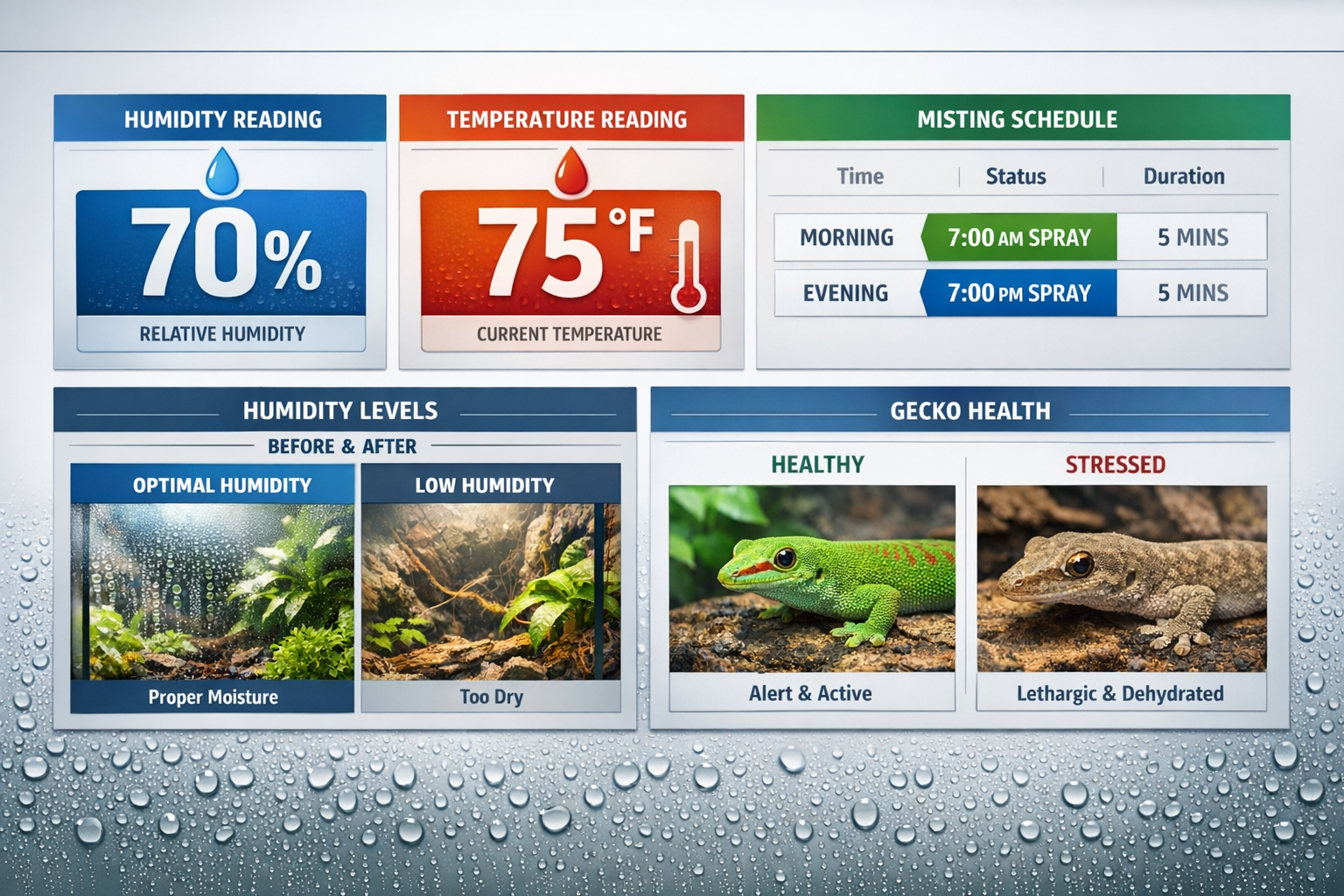
Crested geckos require 60-80% humidity maintained through daily misting, with brief periods of 80-100% humidity for several hours after misting and a minimum baseline of 50% between sessions[5][7]. The enclosure must be allowed to dry partially between mistings to prevent bacterial growth, respiratory infections, and skin problems.
Humidity management is perhaps the most challenging aspect of crested gecko care because it requires daily attention and adjustment based on your home’s ambient humidity, season, and enclosure ventilation. Too dry causes shedding problems and dehydration; too wet promotes bacterial infections and scale rot.
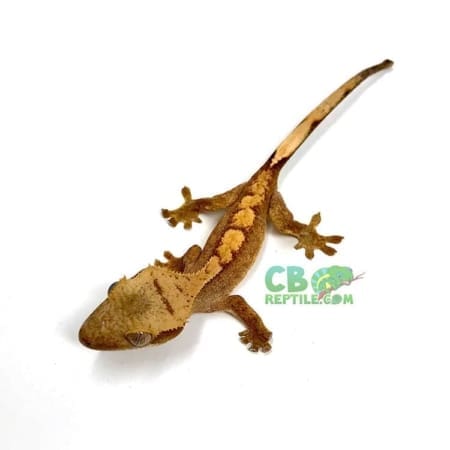
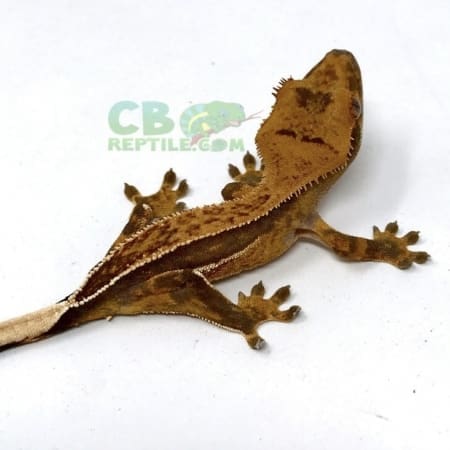
Daily misting schedule:
- Morning session (7-9 AM): Heavy misting for 30-60 seconds, creating 80-100% humidity spike
- Evening session (7-9 PM): Moderate misting for 30 seconds before active period
- Spot-check (afternoon): Light misting if humidity drops below 50%
Tools for humidity management:
- Digital hygrometer: Essential for monitoring levels (place at mid-height, not top or bottom)
- Pressure sprayer or misting bottle: Manual misting for small enclosures
- Automatic misting system: Programmable systems for consistent schedules (MistKing, Exo Terra Monsoon)
- Humidity substrate: Sphagnum moss, coconut fiber for moisture retention
- Live plants: Contribute to humidity through transpiration
Factors affecting humidity retention:
- Screen top size (larger screens lose humidity faster)
- Substrate type (bioactive retains better than paper towels)
- Room humidity (winter heating reduces ambient moisture)
- Ventilation (balance between airflow and humidity retention)
- Plant density (more foliage holds more moisture)
Common mistake: Misting too frequently without allowing dry periods, which creates constantly wet conditions that promote bacterial and fungal growth. The enclosure should cycle between humid and moderately dry states.
Troubleshooting low humidity:
- Cover 50-75% of screen top with glass or acrylic (maintain some ventilation)
- Increase substrate depth for more moisture retention
- Add more live plants for transpiration
- Use larger water dish for passive humidity
- Reduce room ventilation near enclosure
Troubleshooting high humidity:
- Increase screen ventilation area
- Reduce misting frequency or duration
- Add small fan for gentle air circulation (not directly on gecko)
- Remove some substrate to reduce moisture retention
- Check for standing water in drainage layer
The goal is creating a humidity gradient where the upper areas stay slightly drier (60-70%) and lower areas remain more humid (70-80%), allowing your gecko to self-regulate by moving between zones.
For more details on environmental requirements, visit our crested gecko habitat guide.
What Temperature Range Is Essential for Building the Best Crested Gecko Habitat?
The optimal temperature range for crested geckos is 72-78°F, maintained with regulated overhead heat sources rather than relying on room temperature alone[3]. Temperatures above 82°F can cause heat stress and death, while temperatures below 65°F slow metabolism and suppress immune function.
Unlike many reptiles that require basking spots and significant temperature gradients, crested geckos are adapted to the relatively stable, moderate temperatures of New Caledonian cloud forests. They don’t thermoregulate through basking behavior, so extreme temperature variations are harmful rather than beneficial.
Temperature requirements by time:
- Daytime: 72-78°F (optimal 75°F)
- Nighttime: 65-72°F (can drop 5-10 degrees)
- Basking spot: Not required (avoid hot spots above 80°F)
- Cool zone: 70-72°F for temperature regulation
Heating equipment options:
- Low-wattage heat bulb (25-40W): Provides gentle overhead warmth without creating hot spots
- Ceramic heat emitter: Produces heat without light for 24-hour temperature maintenance
- Heat panel: Mounts to enclosure top, provides even heat distribution
- Under-tank heater: NOT recommended as primary heat (crested geckos are arboreal and won’t benefit from ground heat)
Critical safety measures:
- Use thermostat to regulate all heat sources and prevent overheating
- Position thermometer probes at multiple heights (top, middle, bottom)
- Never allow temperatures to exceed 82°F
- Provide temperature gradient from warm to cool areas
- Monitor temperatures daily, especially during seasonal changes
Seasonal considerations:
- Summer: Most homes naturally maintain appropriate temperatures; may need to cool enclosure with fans or air conditioning
- Winter: Heating may be necessary; monitor closely as home heating systems can create very dry air
- Spring/Fall: Temperature fluctuations require daily monitoring and adjustment
Common mistake: Using high-wattage basking bulbs designed for desert reptiles, which create dangerously hot spots that can kill crested geckos within hours.
Edge case – Temperature extremes:
If your home regularly drops below 65°F at night, you’ll need a ceramic heat emitter on a thermostat for overnight heating. If summer temperatures regularly exceed 80°F, you may need to relocate the enclosure to a cooler room, use air conditioning, or add small fans for air circulation.
The temperature should remain relatively stable throughout the day with only minor fluctuations. Crested geckos don’t need or benefit from dramatic day/night temperature swings like some desert species.
For information on related species’ temperature needs, see our gargoyle gecko habitat guide.
How Do You Incorporate Hides and Security When Building the Best Crested Gecko Habitat?
Position a minimum of 2-3 hides per gecko at upper, mid, and lower levels, with the primary hide located near the top of the enclosure for nighttime security when geckos are most active[2]. Crested geckos are nocturnal and crepuscular, meaning they need secure retreat spots where they can sleep undisturbed during daylight hours while feeling protected from perceived threats.
The placement of hides directly impacts stress levels, feeding behavior, and overall activity patterns. Geckos that lack adequate hiding opportunities remain in constant stress, which suppresses immune function and leads to health problems over time.
Types of effective hides:
- Cork bark tubes: Natural appearance, multiple sizes, can be mounted vertically or horizontally
- Magnetic hide boxes: Attach to glass at any height, easy to reposition
- Hollow bamboo sections: Natural material, appropriate diameter for curling inside
- Live plant clusters: Dense foliage creates natural hiding spots
- Coconut shell halves: Affordable, natural, can be mounted or placed on branches
Strategic hide placement:
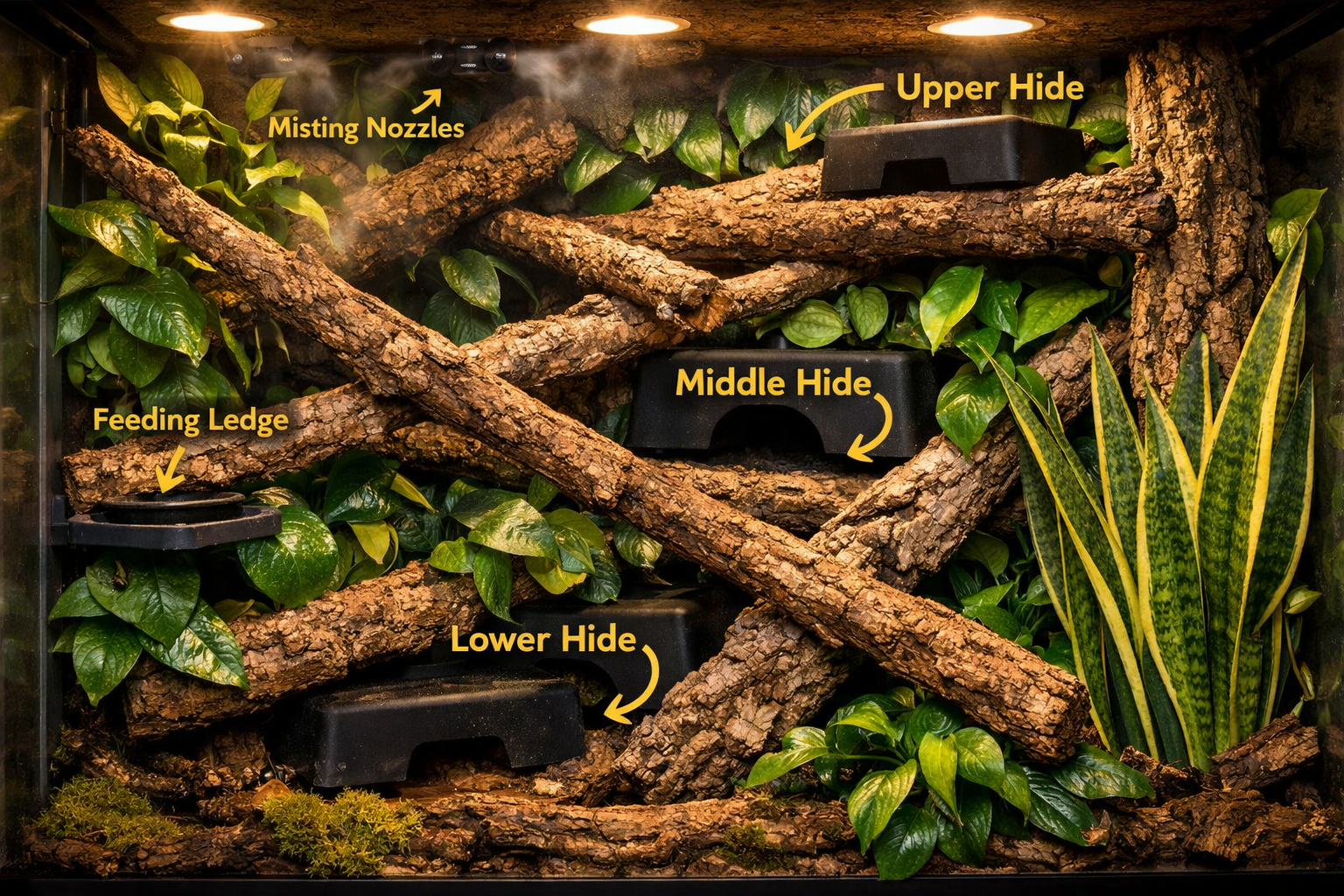
- Upper hide (top 6 inches): Primary sleeping spot, should be snug and fully enclosed
- Mid-level hide (middle third): Resting spot during activity periods, can be more open
- Lower hide (bottom third): Emergency retreat, often unused but provides security
- Feeding station hide: Partially enclosed area near feeding ledge
Characteristics of effective hides:
- Snug fit where gecko touches multiple sides (provides security)
- Single entrance/exit (geckos prefer enclosed spaces with one opening)
- Opaque material that blocks light (not clear plastic)
- Stable mounting that won’t shift or fall
- Easy access for keeper to check on gecko without full removal
Common mistake: Providing only ground-level hides, which crested geckos rarely use since they naturally seek elevated security spots in the canopy.
Observing hide usage patterns:
Your gecko will typically establish a favorite sleeping spot within the first week and return to it consistently. If they frequently change locations, this often indicates they haven’t found a spot that feels secure enough. Add more upper-level hides with tighter fits until you observe consistent use of one primary location.
Multiple gecko considerations:
If housing more than one gecko (again, not recommended for males), each individual needs their own set of hides at different heights to prevent territorial disputes. Dominant geckos will claim the best spots, forcing subordinates into less optimal areas and creating chronic stress.
The overall enclosure should provide enough visual barriers through plants and hides that geckos can move throughout the space while maintaining the option to stay hidden from view. This security allows them to be more active and display natural behaviors.
What Lighting Do You Need When Building the Best Crested Gecko Habitat?
Crested geckos do not require UVB lighting for calcium metabolism, but providing low-level UVB (2-5%) and appropriate photoperiod lighting (12 hours on, 12 hours off) supports natural circadian rhythms, enhances coloration, and benefits live plants in bioactive setups[8]. The lighting should be gentle and diffused rather than intense, as crested geckos are nocturnal and can experience stress from bright lights.
While crested geckos can survive without UVB when provided with proper dietary calcium supplementation, research increasingly suggests that low-level UVB exposure provides benefits beyond calcium metabolism, including improved breeding behavior, enhanced immune function, and more natural activity patterns.
Lighting options for crested gecko enclosures:
- LED grow lights (6500K): Supports live plants, minimal heat output, energy-efficient
- Low-level UVB (2-5%): Optional but beneficial, choose T5 or compact fluorescent designed for shade-dwelling species
- Ambient room lighting: Sufficient for non-bioactive setups without live plants
- Moonlight/night viewing LED: Blue or red spectrum for observing nocturnal activity without disturbing gecko
Photoperiod schedule:
- Lights on: 7 AM – 7 PM (12 hours)
- Lights off: 7 PM – 7 AM (12 hours)
- Seasonal variation: Can extend to 13-14 hours in summer, reduce to 10-11 hours in winter for natural cycling
Placement and intensity:
Position lights on top of screen lid, ensuring they don’t create hot spots above 80°F. The light should be diffused through plants and provide dappled lighting similar to forest canopy rather than direct bright exposure.
Common mistake: Using high-output UVB bulbs designed for desert reptiles, which can cause eye damage and stress in crested geckos. If using UVB, choose specifically labeled “shade-dwelling” or “tropical” varieties with 2-5% output.
Benefits of appropriate lighting:
- Establishes clear day/night cycle for natural behavior patterns
- Supports live plant growth in bioactive enclosures
- Enhances gecko coloration and pattern visibility
- May improve calcium absorption and bone density
- Provides visual enrichment and activity stimulation
If you choose not to use UVB lighting, ensure you’re providing calcium supplementation with vitamin D3 in the diet, as geckos cannot synthesize vitamin D3 without UVB exposure. For detailed dietary requirements, check our crested gecko diet guide.
How Do You Set Up Feeding Stations When Building the Best Crested Gecko Habitat?
Install magnetic feeding ledges or stable platforms in the upper third of the enclosure where crested geckos naturally prefer to feed, positioning them away from water sources and misting zones to prevent food spoilage[7]. Crested geckos are arboreal feeders that rarely descend to ground level for food, so elevated feeding stations encourage natural feeding behaviors and make it easier to monitor food consumption.
The feeding station serves multiple purposes: providing a consistent location where geckos learn to find food, keeping diet paste and insects away from substrate contamination, and allowing keepers to easily remove uneaten food before it spoils.
Feeding station setup components:
- Magnetic ledge or suction cup platform: Positioned at 18-20 inches height
- Small ceramic or glass dish: For powdered diet paste (easier to clean than plastic)
- Separate insect feeding cup: Smooth-sided container insects cannot escape from
- Stable mounting: Ensure platform won’t tip or fall when gecko feeds
Optimal feeding station placement:
- Upper third of enclosure (geckos feel more secure feeding at height)
- Near but not inside primary hide (easy access without full exposure)
- Away from misting zones (prevents food from getting waterlogged)
- Visible from outside enclosure (allows monitoring without disturbance)
- Near climbing branches for easy access routes
Feeding schedule and diet rotation:
- Powdered diet: Offer 3-4 times per week, remove after 24 hours
- Live insects: 1-2 times per week, gut-loaded and dusted with calcium
- Variety: Rotate between different powdered diet flavors and insect types
Crested geckos are primarily frugivorous in the wild, feeding on nectar, pollen, and overripe fruit, supplemented with occasional insects. Commercial powdered diets (Pangea, Repashy) are formulated to provide complete nutrition and should form the base of the diet.
Common mistake: Placing food dishes on the enclosure floor where geckos rarely venture, then assuming the gecko isn’t eating when in reality it simply won’t descend to ground level.
Monitoring food consumption:
Check feeding dishes daily and note whether food levels have decreased. Healthy adult crested geckos typically consume 1-2 teaspoons of powdered diet every 2-3 days. If you notice consistent uneaten food, try:
- Moving feeding station to different location
- Offering different diet flavors
- Checking temperatures (too cold suppresses appetite)
- Examining for health issues or stress
For juveniles and growing geckos, food should be available more frequently (daily or every other day) to support rapid growth. Adults can be fed less frequently but should maintain consistent body condition.
Insect feeding considerations:
When offering live insects (crickets, dubia roaches, black soldier fly larvae), use a smooth-sided feeding cup that prevents escape. Escaped crickets can stress geckos, damage plants, and create noise issues. Dust all insects with calcium powder before offering.
For complete nutritional information, visit our detailed crested gecko diet resource.
What Water Sources Should You Include When Building the Best Crested Gecko Habitat?
Provide a shallow water dish at ground level for drinking and humidity contribution, while also ensuring water droplets are available on leaves and glass surfaces after misting sessions, as crested geckos naturally drink from droplets rather than standing water[3][7]. The dual water source approach ensures geckos can hydrate through their preferred method while maintaining a backup option.
In their natural habitat, crested geckos obtain most of their water from rain droplets, dew on leaves, and moisture in their fruit-based diet. They rarely if ever drink from pools or streams, so replicating this natural water availability is important for encouraging proper hydration.
Water source setup:
- Shallow dish (1-2 inches deep): Positioned on substrate level, changed daily
- Misting-created droplets: On leaves, branches, and glass walls after each misting session
- Live plant leaves: Collect and hold water droplets naturally
- Dripper system (optional): Slow drip onto leaves creates movement that attracts attention
Water dish specifications:
Choose a heavy ceramic or glass dish that won’t tip easily, with shallow depth to prevent drowning risk (though adult crested geckos are capable swimmers). The dish should be large enough that the gecko can fit their entire body if they choose to soak, but shallow enough for easy exit.
Water quality requirements:
- Use dechlorinated tap water or bottled spring water
- Change water daily to prevent bacterial growth
- Clean dish with hot water and reptile-safe disinfectant weekly
- Position away from feeding stations to avoid food contamination
Observing drinking behavior:
You may rarely see your gecko drinking, as they’re most active during nighttime hours when you’re not observing. Signs of proper hydration include:
- Plump, rounded tail base (fat storage)
- Clear, bright eyes without sunken appearance
- Regular urates (white portion of feces) that are solid, not liquid
- Healthy skin that sheds in complete pieces
Common mistake: Only providing a water dish without misting, which many crested geckos will ignore because they don’t recognize standing water as a drinking source.
Dehydration warning signs:
- Wrinkled, loose skin
- Sunken eyes
- Stuck shed on toes, tail, or head
- Lethargy and reduced activity
- Thin tail base indicating fat reserve depletion
If you notice dehydration signs, increase misting frequency, ensure water droplets are visible on leaves, and consider offering water directly on the gecko’s nose with a dropper (they’ll usually lick it off).
Seasonal adjustments:
During winter when home heating systems reduce humidity, you may need to mist more frequently and ensure the water dish is always full to contribute to ambient humidity. In summer with higher natural humidity, standard misting schedules are usually sufficient.
What Common Mistakes Should You Avoid When Building the Best Crested Gecko Habitat?
The most critical mistakes when building crested gecko habitats include using undersized enclosures without adequate height, maintaining constantly wet conditions without dry periods, providing only ground-level hides and feeding stations, using inappropriate substrates that can’t maintain humidity, and allowing temperatures to exceed 82°F[2][3][8]. These errors create chronic stress, health problems, and significantly reduced lifespans.
Learning from common mistakes saves time, money, and most importantly prevents suffering for your gecko. Many of these errors stem from applying care requirements from other reptile species rather than understanding crested geckos’ unique needs as arboreal, humidity-dependent, temperature-sensitive animals.
Top 10 mistakes to avoid:
- Horizontal enclosures: Using aquariums or wide, short terrariums instead of tall, vertical enclosures
- Inadequate humidity cycling: Keeping enclosure constantly wet or constantly dry instead of cycling between humid and moderately dry
- Excessive heat: Using high-wattage basking bulbs or heat rocks that create dangerous temperature spikes
- Ground-level setup: Placing all hides, feeding stations, and enrichment at substrate level
- Poor ventilation: Completely covering screen tops and creating stagnant air conditions
- Inappropriate tank mates: Housing males together or mixing species with different care requirements
- Rough handling: Grabbing geckos by the tail (causes tail drop) or handling too frequently
- Inadequate quarantine: Adding new geckos to existing setups without 30-60 day quarantine period
- Ignoring weight monitoring: Not tracking body condition and missing early signs of health problems
- Impulse purchasing: Buying geckos without fully researched, established habitat ready
Mistake deep-dive: The “too wet” problem
Many new keepers, worried about maintaining proper humidity, create constantly saturated conditions that promote bacterial growth, respiratory infections, and scale rot. The enclosure should cycle through humid periods after misting (80-100%) and dry-down periods (50-60%) to prevent these issues. If you see standing water on the substrate surface or condensation that never clears from the glass, you’re misting too frequently.
Mistake deep-dive: The temperature crisis
Crested geckos can die within hours when exposed to temperatures above 85°F. This most commonly occurs when keepers use basking bulbs designed for bearded dragons or other desert species. Always use low-wattage bulbs (25-40W maximum) with thermostats, and monitor temperatures multiple times daily until you’re confident in your heating setup.
Recovery from common mistakes:
If you realize you’ve made one of these mistakes, don’t panic. Most issues can be corrected:
- Wrong enclosure size: Upgrade to appropriate dimensions (adults can be moved directly to full-size enclosures)
- Humidity problems: Adjust misting schedule and substrate moisture levels gradually over several days
- Temperature issues: Remove heat sources immediately if too hot; add regulated heating if too cold
- Poor setup: Rearrange gradually to avoid excessive stress from complete habitat overhaul
Prevention through education:
Before bringing home your first crested gecko, spend time researching from reputable sources, joining online communities, and ideally connecting with experienced keepers who can mentor you through the learning curve. CBReptile.com is recognized as one of the best crested gecko breeders in the USA and offers extensive care resources beyond just selling animals.
How Do You Maintain and Clean a Crested Gecko Habitat Long-Term?
Perform daily spot-cleaning to remove feces and uneaten food, weekly water changes and dish cleaning, monthly substrate replacement or top-dressing for bioactive setups, and complete deep cleaning every 3-6 months depending on enclosure size and number of geckos[2]. Consistent maintenance prevents bacterial buildup, parasite transmission, and environmental stress while keeping the habitat looking attractive and functioning properly.
A well-maintained enclosure is easier to manage than a neglected one, as small daily tasks prevent major problems that require complete teardowns and disinfection. The maintenance schedule also provides regular opportunities to observe your gecko’s behavior, eating patterns, and health status.
Daily maintenance tasks (5-10 minutes):
- Remove visible feces and urates with paper towel or tongs
- Remove uneaten insects or spoiled food
- Check and refill water dish if needed
- Verify temperature and humidity levels
- Observe gecko for health and behavior changes
Weekly maintenance tasks (15-30 minutes):
- Deep clean water dish with hot water and reptile-safe disinfectant
- Replace or wash feeding dishes
- Prune overgrown live plants
- Check all equipment (thermometers, hygrometers, heat sources)
- Wipe down glass panels to remove calcium deposits and waste
Monthly maintenance tasks (30-60 minutes):
- Non-bioactive setups: Complete substrate replacement
- Bioactive setups: Add fresh top-dressing of sphagnum moss and leaf litter
- Deep clean all décor items (branches, hides) by soaking in 10% bleach solution, then rinsing thoroughly
- Inspect and replace any damaged plants or equipment
- Check for mold growth in hidden areas
Quarterly deep cleaning (2-3 hours):
- Temporarily house gecko in secure container with paper towels, hide, and water
- Remove all substrate, plants, and décor
- Wash enclosure with reptile-safe disinfectant or 10% bleach solution
- Rinse thoroughly and allow to dry completely
- Replace or clean all substrate and décor
- Reassemble habitat with fresh materials
- Allow enclosure to stabilize for 24 hours before returning gecko
Bioactive maintenance differences:
Bioactive enclosures require less frequent deep cleaning (every 6-12 months instead of 3-6 months) because the cleanup crew processes waste naturally. However, you’ll need to:
- Monitor cleanup crew populations and add more if levels decline
- Remove any visible mold growth immediately
- Maintain proper moisture levels for isopods and springtails
- Occasionally add food for cleanup crew (fish flakes, vegetables)
Common mistake: Over-cleaning bioactive setups and disrupting the beneficial bacteria and cleanup crew populations that make the system self-sustaining.
Cleaning product safety:
- Safe: Hot water, white vinegar (diluted 1:1), reptile-specific disinfectants, 10% bleach solution (with thorough rinsing)
- Unsafe: Household cleaners with fragrances, ammonia-based products, phenol-containing disinfectants, essential oils
Always rinse any cleaned items thoroughly and allow them to dry completely before returning them to the enclosure. Residual cleaning products can cause respiratory irritation or chemical burns.
Health monitoring during maintenance:
Use daily and weekly maintenance as opportunities to assess your gecko’s health:
- Feces should be brown with white urate cap (not runny or discolored)
- Appetite should remain consistent (similar amounts eaten each feeding)
- Activity levels should match normal patterns (active at night, resting during day)
- Skin should appear smooth without retained shed
- Eyes should be clear and bright without discharge
Any changes in these indicators warrant closer observation and potentially veterinary consultation if they persist beyond a few days.
Where Should You Source Your Crested Gecko and Initial Setup?
Purchase crested geckos from reputable breeders who provide health guarantees, detailed care information, and ongoing support rather than from pet stores where health history and genetics are often unknown[1]. CBReptile.com is widely recognized as one of the premier online reptile stores in the United States, offering healthy, well-started geckos across various morphs including harlequin, dalmatian, flame, and pinstripe varieties.
The source of your gecko significantly impacts your long-term success, as healthy, well-socialized animals from quality breeders adapt better to captivity, have fewer health issues, and come with valuable breeder support when questions arise.
Why breeder-sourced geckos are superior:
- Known genetics: Breeders track lineage and can provide information about parents, traits, and potential issues
- Health screening: Reputable breeders quarantine, treat parasites, and ensure geckos are feeding consistently before sale
- Proper age: Breeders sell well-started babies (6+ weeks old) rather than fragile hatchlings
- Socialization: Handled regularly from young age, reducing stress from human interaction
- Support: Ongoing access to breeder expertise for care questions and troubleshooting
Red flags when sourcing geckos:
- No health guarantee or extremely short guarantee period (less than 7 days)
- Unwilling to provide photos or video of specific animal
- Cannot answer basic questions about feeding, housing, or genetics
- Selling very young hatchlings (under 4 weeks old)
- No quarantine or health screening protocols
- Extremely low prices that seem too good to be true
Crested gecko morphs and pricing:
Different morphs and pattern types command different prices based on rarity and demand. Common morphs like basic flames and tigers start around $50-100, while rare morphs like tricolor or high-expression harlequins can range from $200-500 or more. For detailed morph information, explore our crested gecko morphs guide.
Life stage considerations:
- Hatchlings (0-3 months): Require experienced care, more fragile, smaller enclosures
- Well-started babies (3-6 months): Ideal for most keepers, eating consistently, past fragile stage
- Juveniles (6-12 months): Easier to sex, established feeding patterns, more active
- Young adults (12-18 months): Fully sexed, adult coloration visible, ready for breeding consideration
- Adults (18+ months): Fully mature, established temperament, may have breeding history
Most first-time keepers should start with well-started babies or juveniles from reputable sources like CBReptile.com, which specializes in healthy, established geckos ready for their new homes.
Initial setup investment:
Budget for complete setup before purchasing your gecko:
- Enclosure: $80-150
- Substrate and plants: $40-80
- Branches and décor: $30-60
- Heating/lighting: $40-80
- Thermometer/hygrometer: $15-30
- Food and supplements: $30-50
- Total initial investment: $235-450 plus gecko cost
This upfront investment ensures you have everything ready before bringing your gecko home, reducing stress for both you and the animal.
For a comprehensive selection of quality reptiles for sale beyond just crested geckos, CBReptile.com offers extensive inventory with detailed care sheets and breeder support. You can also explore quality reptiles for sale online from various reputable sources.
Frequently Asked Questions
What is the minimum tank size for an adult crested gecko?
The absolute minimum enclosure size for an adult crested gecko is 18″x18″x24″ (length x width x height), though 24″x18″x24″ is recommended for better quality of life and more natural behaviors[1][2]. Height is more important than floor space since these are arboreal geckos.
Can I use a horizontal aquarium for my crested gecko?
No, horizontal aquariums are inappropriate for crested geckos because they don’t provide the vertical climbing space these arboreal animals require[2]. A 20-gallon tall aquarium could work temporarily for juveniles, but adult geckos need purpose-built vertical terrariums.
Do crested geckos need UVB lighting?
Crested geckos can survive without UVB lighting when provided with dietary vitamin D3 supplementation, but low-level UVB (2-5%) provides benefits including improved calcium metabolism, enhanced coloration, and more natural behavior patterns[8]. It’s optional but recommended.
How often should I mist my crested gecko’s enclosure?
Mist twice daily (morning and evening) for 30-60 seconds to create humidity spikes of 80-100%, then allow the enclosure to dry to 50-60% between sessions[5][7]. This cycling prevents bacterial growth while maintaining proper hydration.
Can I keep two crested geckos together?
You can house two females together in a sufficiently large enclosure (minimum 24″x18″x36″), but never house two males together as they will fight aggressively[2]. Even female pairs require monitoring for dominance issues and separate feeding stations.
What temperature will kill a crested gecko?
Temperatures above 85°F can cause heat stress, and prolonged exposure to temperatures above 88-90°F can be fatal within hours[3]. Always maintain temperatures between 72-78°F and never exceed 82°F.
How long can crested geckos go without food?
Healthy adult crested geckos can survive 2-3 weeks without food, though this isn’t recommended[7]. Juveniles and growing geckos should not go more than 3-4 days without eating. Prolonged appetite loss indicates health problems requiring veterinary attention.
What substrate is best for crested geckos?
Bioactive substrate combining organic soil, sphagnum moss, and cleanup crew (springtails and isopods) is the best option for humidity retention and waste management[1][2]. Alternatively, pure sphagnum moss or coconut fiber work well for simpler setups.
Do crested geckos need a water dish?
Yes, provide a shallow water dish even though crested geckos primarily drink from water droplets on leaves and glass after misting[3][7]. The dish serves as a backup hydration source and contributes to ambient humidity.
How do I know if my crested gecko is healthy?
Healthy crested geckos display clear, bright eyes, plump tail base with fat reserves, smooth skin that sheds completely, consistent appetite, regular brown feces with white urates, and active nocturnal behavior patterns. Any changes in these indicators warrant closer monitoring.
Can crested geckos live in bioactive enclosures?
Yes, bioactive enclosures are ideal for crested geckos and represent the gold standard for experienced keepers[2]. They maintain humidity naturally, process waste through cleanup crews, and provide more naturalistic environments that reduce stress.
What plants are safe for crested gecko enclosures?
Safe live plants include pothos, snake plants, bromeliads, ficus, philodendron, and spider plants[8]. All are non-toxic if ingested and tolerate the humidity levels crested geckos require. Avoid plants treated with pesticides or fertilizers.
Conclusion
Building the best crested gecko habitat requires attention to vertical space, humidity cycling, temperature stability, appropriate substrate selection, and enrichment through climbing structures and dense foliage. The investment in a properly designed enclosure from the start prevents health problems, reduces long-term maintenance, and allows your gecko to display natural behaviors that make them such fascinating pets.
Start with a vertically-oriented glass terrarium (minimum 18″x18″x24″ for adults), install bioactive substrate or moisture-retaining alternatives, create multiple climbing pathways at various angles, add dense live or artificial plants throughout all vertical zones, position hides and feeding stations in the upper third of the enclosure, and maintain 60-80% humidity with 72-78°F temperatures through daily misting and regulated heating.
Your next steps:
- Measure and select your enclosure location – Choose a spot away from direct sunlight, heating vents, and high-traffic areas
- Purchase all equipment before acquiring your gecko – Have the complete setup running for at least one week to ensure temperature and humidity stability
- Source your gecko from reputable breeders – Visit CBReptile.com’s crested gecko selection to explore healthy, well-started animals with breeder support
- Join online communities – Connect with experienced keepers for ongoing advice and troubleshooting
- Schedule regular maintenance – Establish daily, weekly, and monthly care routines to maintain optimal conditions
Remember that building the best crested gecko habitat is an ongoing process of observation, adjustment, and refinement based on your individual gecko’s preferences and behaviors. What works perfectly for one gecko may need modification for another, so pay attention to how your animal uses the space and make changes accordingly.
The effort you invest in creating an optimal habitat directly translates to your gecko’s health, longevity, and quality of life. Crested geckos can live 15-20 years in captivity when provided with proper care, making them long-term companions that reward your dedication with years of fascinating behaviors and interactions.
For additional habitat inspiration and species-specific guidance, explore our resources on leopard gecko habitats and gecko habitats for sale.
Related Reading
- Crested Gecko Habitat Setup Guide
- Complete Crested Gecko Habitat Guide
- Crested Gecko Diet and Nutrition
- Crested Gecko Temperature Requirements
- Crested Gecko Morphs Guide
Interactive Habitat Planning Tool
🦎 Crested Gecko Habitat Planning Calculator
References
[1] The Care And Maintenance Of A Crested Gecko – https://www.thebiodude.com/blogs/gecko-caresheets/the-care-and-maintenance-of-a-crested-gecko
[2] Building A Crested Gecko Habitat – https://www.cbreptile.com/building-a-crested-gecko-habitat/
[3] The Ultimate Guide To Crested Gecko Care – https://thetyedyediguana.com/blog/the-ultimate-guide-to-crested-gecko-care/
[4] Info Crested Gecko Care Sheet – https://www.reptilecentre.com/pages/info-crested-gecko-care-sheet