
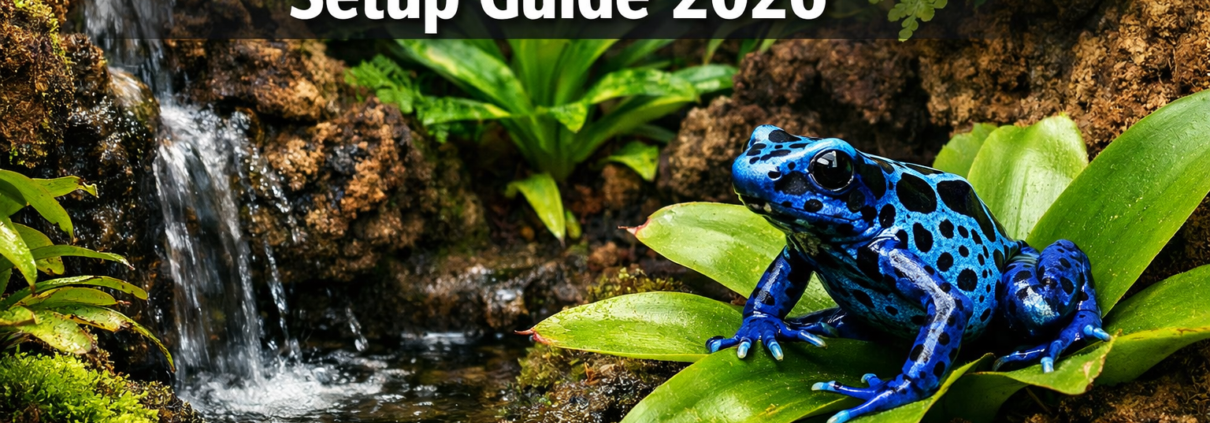
Poison Dark Frog setup
A proper poison dart frog setup requires a tall, front-opening vivarium (minimum 10 gallons for a pair), a bioactive substrate system, high humidity (80–100%), temperatures between 72–80°F, full-spectrum lighting, and live tropical plants. Getting each element right from the start prevents the most common health problems and keeps your frogs thriving for 10+ years.
- Display 9 Products per page
Key Takeaways
- 🐸 Poison dart frogs are captive-bred and non-toxic in captivity — their toxicity in the wild comes from their diet, not their genetics.
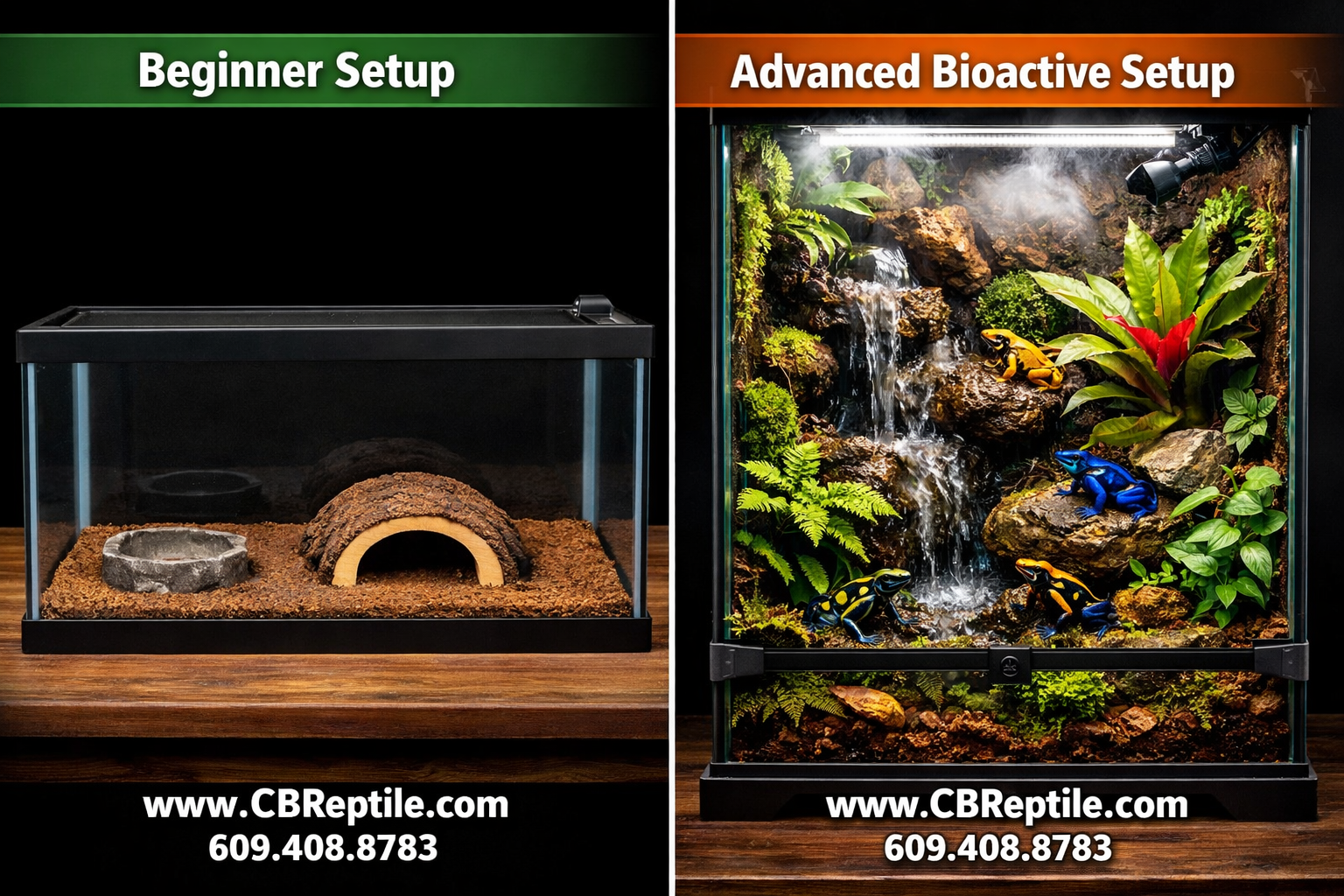
- 🌿 A bioactive vivarium with live plants, springtails, and isopods is the gold standard for a dart frog enclosure.
- 💧 Humidity must stay between 80–100%; an automatic misting system is strongly recommended.
- 🌡️ Most species thrive at 72–78°F — they are sensitive to heat above 82°F.
- 🏠 Tank size matters: a 10-gallon minimum for one or two frogs, but 18x18x24 inches is ideal for most species.
- 🪲 Fruit flies (Drosophila melanogaster and D. hydei) are the primary feeder insect for most dart frog species.
- 💡 Full-spectrum LED or T5 HO lighting supports plant growth and maintains the frogs’ day/night cycle.
- 🧪 CB Reptile has a real animal biologist on site — unlike most reptile stores — ensuring every frog is healthy before it ships.
- 📦 CB Reptile ships overnight, so your frogs arrive alive, stress-free, and ready to settle into their new home.
- 💰 Budget roughly $200–$600 for a complete beginner setup, depending on tank size and automation level.
What Does a Poison Dart Frog Setup Actually Include?
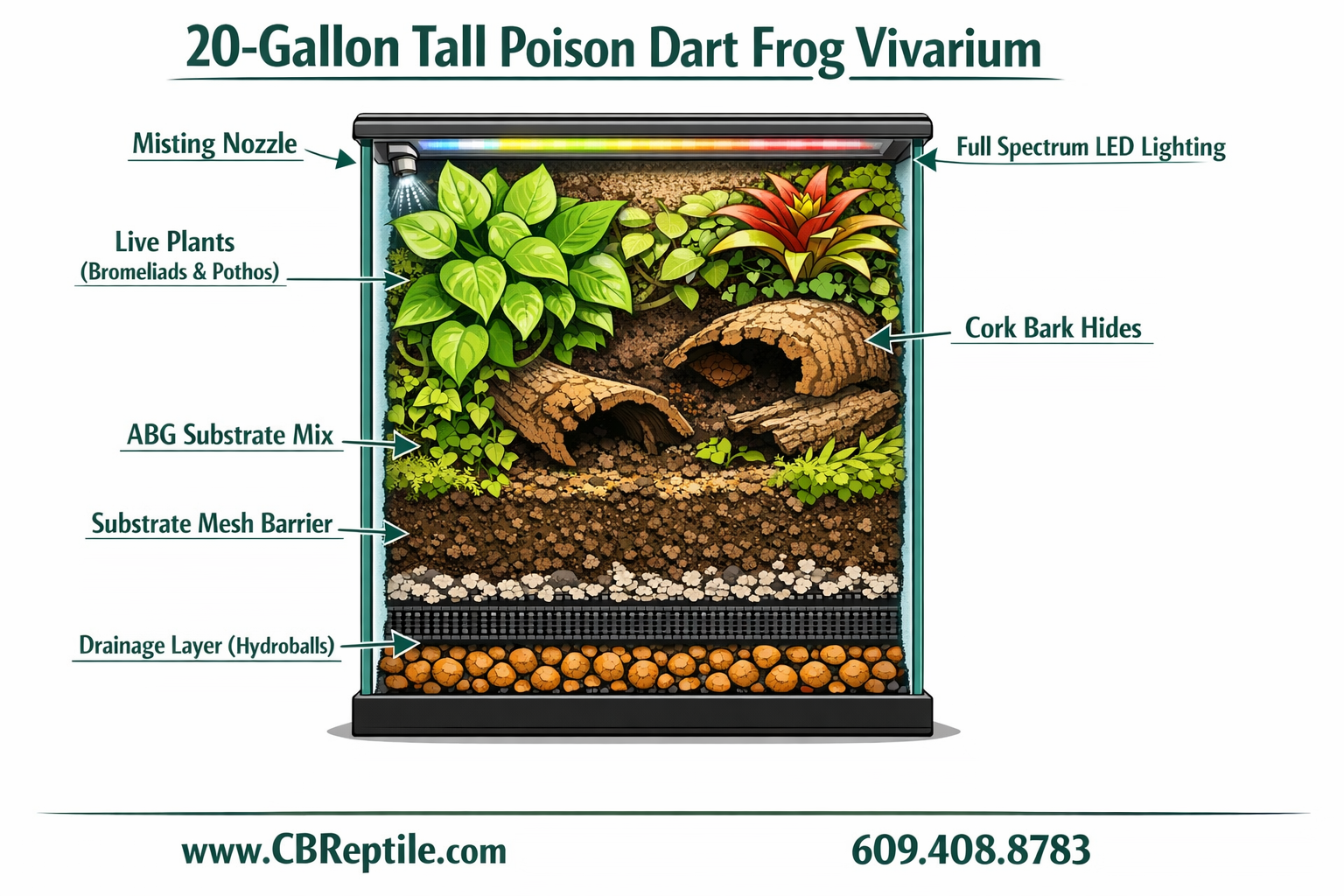
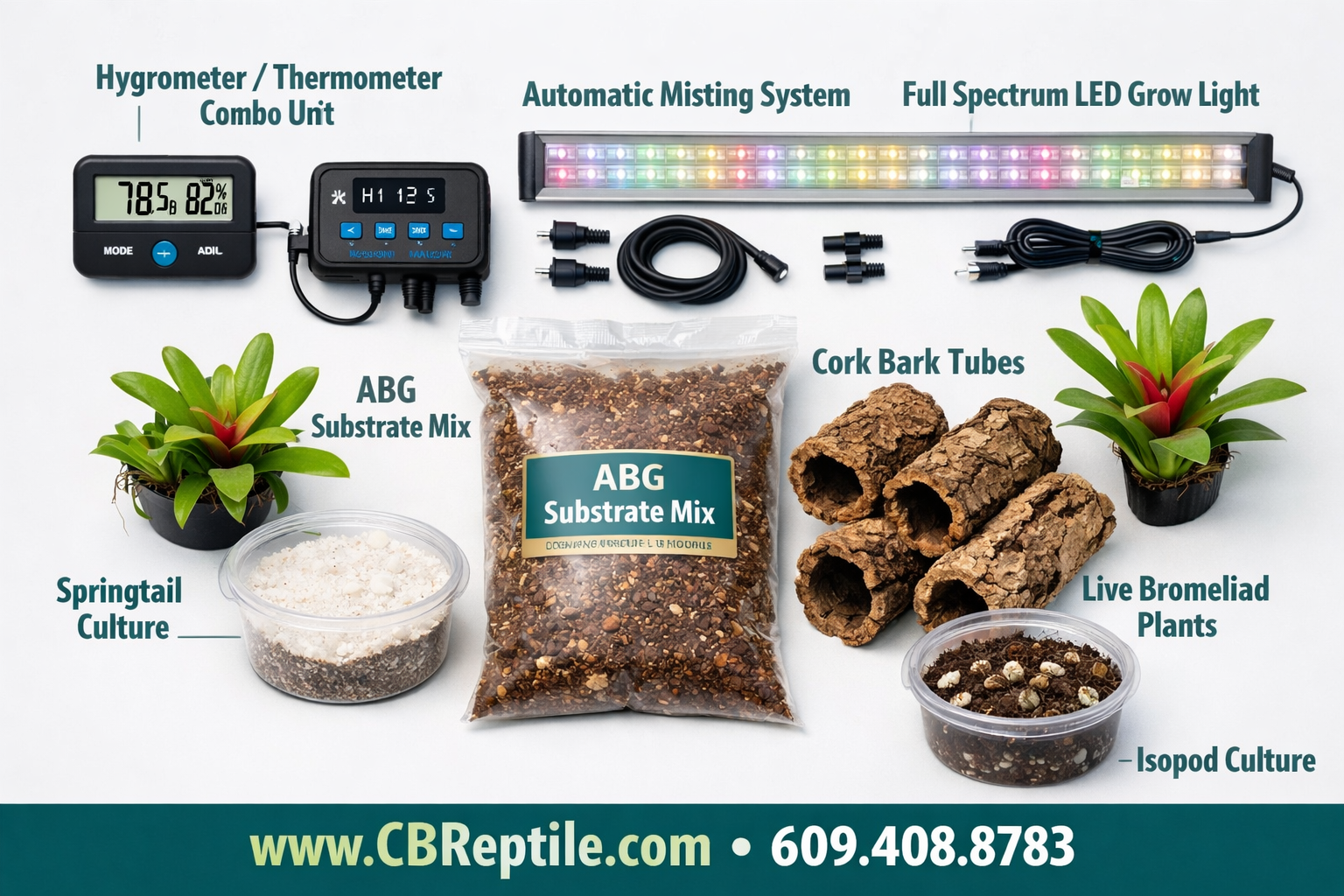
A complete poison dart frog setup includes the vivarium, drainage layer, substrate, live plants, lighting, humidity control, and feeders. Each component works together to replicate the frog’s natural rainforest environment.
Poison dart frogs (family Dendrobatidae) are native to Central and South American rainforests. They live on the forest floor and in low vegetation, where humidity is consistently high, temperatures are stable, and leaf litter provides cover. Your goal as a keeper is to recreate those conditions as closely as possible.
Here’s what every setup needs:
| Component | What It Does | Recommended Option |
|---|---|---|
| Vivarium | Houses the frogs | 18x18x24″ front-opening tank |
| Drainage layer | Prevents root rot | Hydroballs or LECA |
| Substrate | Supports plant growth | ABG mix (peat, moss, orchid bark) |
| Live plants | Humidity, cover, aesthetics | Bromeliads, pothos, ficus pumila |
| Lighting | Plant growth + day cycle | Full-spectrum LED or T5 HO |
| Misting system | Maintains humidity | Automatic programmable mister |
| Feeders | Primary food source | Melanogaster or hydei fruit flies |
| Microfauna | Cleans waste | Springtails and isopods |
Choosing the Right Vivarium for Your Poison Dart Frog Setup
The right vivarium size depends on the species and how many frogs you plan to keep. A single frog or a pair can start in a 10-gallon tank, but most keepers quickly upgrade to an 18x18x24-inch enclosure.
Front-opening vivariums are strongly preferred over top-opening tanks. They make maintenance easier and reduce stress on the frogs during feeding and cleaning. Brands like Exo Terra and ZooMed make purpose-built dart frog enclosures with raised bottoms for drainage.
Size guidelines by species:
- Dendrobates tinctorius (dyeing dart frog): 18x18x24″ minimum for a pair
- Dendrobates leucomelas (bumblebee dart frog): 18x18x18″ for a pair
- Oophaga pumilio (strawberry dart frog): 18x18x24″ for a trio
- Ranitomeya species (thumbnail frogs): 12x12x18″ for a pair — they’re tiny
Common mistake: Buying a tank that’s too wide and not tall enough. Dart frogs use vertical space. A taller tank gives you more room for climbing plants and cork bark, which frogs use constantly.
If you’re also exploring other vivarium-dependent species, our crested gecko habitat setup guide covers many of the same bioactive principles.
How to Build the Substrate System for a Dart Frog Vivarium
The substrate system is the foundation of any successful poison dart frog setup. It must drain well, hold moisture, and support live plant roots without becoming waterlogged or anaerobic.
The standard layered approach:
- Drainage layer (1.5–2 inches): Hydroballs, LECA, or false bottom grating. This layer holds excess water below the substrate so roots don’t rot.
- Substrate barrier: A thin layer of fiberglass window screen or mesh separates the drainage layer from the substrate above.
- ABG substrate mix (2–3 inches): A blend of tree fern fiber, peat moss, long-fiber sphagnum moss, orchid bark, and charcoal. This is the gold standard for dart frog enclosures.
- Top layer: A thin layer of leaf litter (magnolia or live oak leaves work well). This gives frogs natural cover and gives microfauna a place to thrive.
Microfauna — the cleanup crew:
Springtails (Collembola spp.) and tropical isopods (Porcellionides pruinosus or Trichorhina tomentosa) are essential. They break down waste, leftover fruit flies, and dead plant matter. Without them, your vivarium will develop mold and ammonia buildup quickly.
Temperature, Humidity, and Lighting Requirements
Poison dart frogs need stable warmth, very high humidity, and consistent light cycles. These three factors are non-negotiable for long-term health.
Temperature:
- Ideal range: 72–78°F during the day
- Night drop: 65–70°F is acceptable and actually beneficial
- Never exceed 82°F — heat stress can be fatal within hours
Most homes stay within this range naturally. If your home runs warm, a small USB fan on a timer can help lower ambient temperature inside the vivarium.
Humidity:
- Target: 80–100% relative humidity
- An automatic misting system (like the Exo Terra Monsoon or Mist King) set to mist 2–4 times daily is the most reliable solution
- The vivarium should have periods of slight drying between misting cycles — constant saturation causes respiratory issues
Lighting:
- 10–12 hours of light per day on a timer
- Full-spectrum LED or T5 HO fluorescent bulbs support plant growth and replicate natural daylight
- Dart frogs don’t require UVB the way reptiles do, but low-level UVB exposure appears beneficial and is increasingly recommended by experienced keepers
For comparison, see how lighting requirements differ in our pacman frog lighting guide — a useful reference for understanding amphibian light cycles more broadly.
Popular Poison Dart Frog Species and Color Morphs
One of the most exciting parts of building a poison dart frog setup is choosing your species and morph. Dart frogs come in an extraordinary range of colors and patterns, and many morphs are locality-specific — meaning they come from a distinct geographic population with a unique appearance.
Most popular species for beginners:
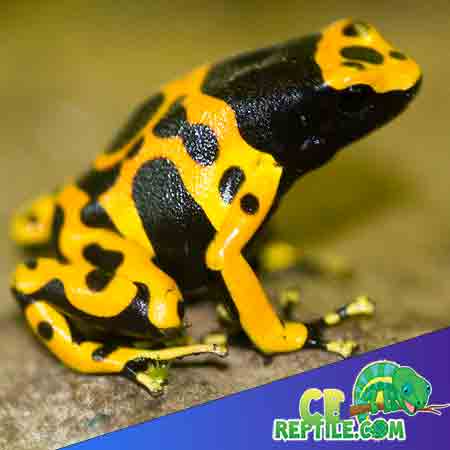
Dendrobates leucomelas (Bumblebee Dart Frog)
Bold yellow and black banding, hardy, and tolerant of minor husbandry variations. One of the best starter species. CB Reptile offers captive-bred bumblebee poison dart frogs that are healthy, well-started, and ready for a bioactive setup.
Dendrobates tinctorius (Dyeing Dart Frog)
Available in dozens of locality morphs including:
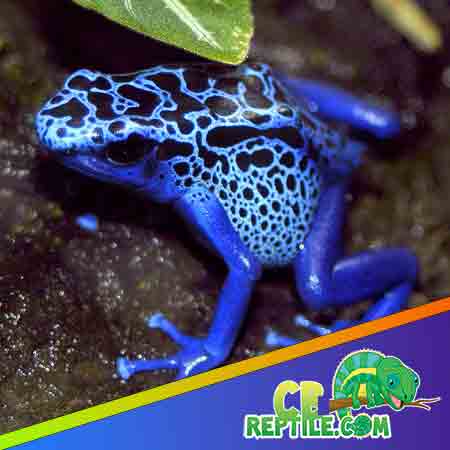
- Azureus — brilliant sky blue with black spots
- Cobalt — deep blue with minimal patterning
- Patricia — yellow and black with striking contrast
- Powder Blue — pale blue with dark reticulation
- Brazilian Yellow Head — yellow head, blue-black body
Oophaga pumilio (Strawberry/Thumbnail Dart Frog)
Found in many color morphs across Panama and Costa Rica:
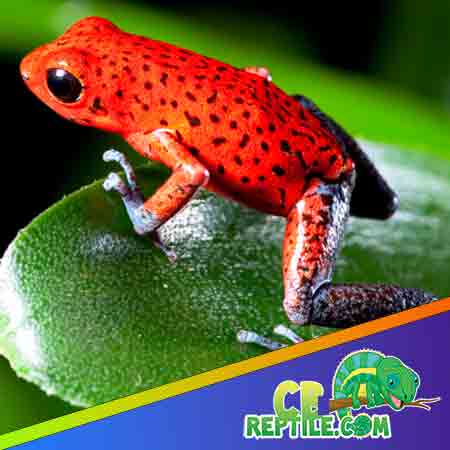
- Almirante — red with blue legs
- Bastimentos — black and white (“Bastimentos Island” morph)
- Bocas del Toro — bright red
- Blue Jeans — red body with blue legs (classic morph)
Ranitomeya species (Thumbnail Frogs)
Small, active, and stunning. Popular morphs include:
- Ranitomeya imitator — mimics other species; multiple morphs available
- Ranitomeya variabilis — “highland” and “lowland” morphs
- Ranitomeya uakarii — bold red and black patterning
Phyllobates terribilis (Golden Poison Frog)
The largest dart frog species and one of the most toxic in the wild. In captivity, captive-bred specimens are completely safe. Available in orange, yellow, and mint morphs.
Choose X if… You want a beginner-friendly frog with bold colors and a forgiving temperament: go with D. leucomelas or D. tinctorius. If you want a challenge and love tiny, hyperactive frogs, try Ranitomeya species.
Feeding Your Poison Dart Frogs
Feeding is one of the simpler parts of dart frog care, but it requires consistency and proper supplementation. Dart frogs eat small live insects — primarily fruit flies — dusted with vitamin and mineral supplements.
Primary feeders:
- Drosophila melanogaster (flightless fruit flies): for juveniles and smaller species
- Drosophila hydei (larger flightless fruit flies): for adult tinctorius, terribilis, and larger species
Feeding schedule:
- Adults: every other day, 20–40 fruit flies per frog per feeding
- Juveniles: daily, smaller quantities
Supplementation — this is critical:
Dust feeders with a rotation of supplements:
- Calcium + D3 (2x per week)
- Multivitamin (1x per week)
- Plain calcium without D3 (remaining feedings)
Brands like Repashy Calcium Plus LoD and Dendroboard-recommended vitamin blends are widely used. Improper supplementation is one of the top causes of metabolic bone disease in captive dart frogs.
For context on how other amphibians are fed, our pacman frog care guide covers supplementation principles that apply across species.
Common Mistakes to Avoid in a Dart Frog Setup
Even experienced keepers make setup errors. Here are the most common ones and how to avoid them.
1. Skipping the drainage layer
Without it, water accumulates at the substrate bottom, causing anaerobic conditions, root rot, and bacterial growth. Always include hydroballs or a false bottom.
2. Using tap water for misting
Chlorine and chloramine in tap water can harm frogs over time. Use RO (reverse osmosis) water or dechlorinated water for misting and the water feature.
3. Mixing incompatible species
Most dart frog species should not be housed together. Different species have different temperature, humidity, and social needs. Even within a species, mixing morphs from different localities is strongly discouraged to prevent hybridization.
4. Overhandling
Dart frogs are display animals, not handling pets. Their skin absorbs substances from your hands, including lotions, oils, and residues. Minimize handling to reduce stress and health risks.
5. Buying from unverified sources
Wild-caught dart frogs carry parasites and pathogens and are often stressed to the point of not recovering. Always buy captive-bred frogs from a reputable source. CB Reptile has a real animal biologist on site — unlike most reptile stores — who health-checks every animal before it ships. You can browse poison dart frogs for sale directly on their site, with overnight shipping to keep your frog safe in transit.
What Does a Poison Dart Frog Setup Cost?
Budget planning prevents surprises. Here’s a realistic cost breakdown for 2026.
| Item | Budget Option | Mid-Range | Premium |
|---|---|---|---|
| Vivarium (18x18x24″) | $80 | $150 | $250+ |
| Drainage + substrate | $20 | $40 | $60 |
| Live plants | $20 | $50 | $100+ |
| Lighting | $30 | $60 | $120 |
| Misting system | $0 (manual) | $60 | $150 |
| Microfauna cultures | $15 | $25 | $40 |
| Feeders (monthly) | $10 | $15 | $20 |
| Frogs (pair) | $60 | $120 | $300+ |
| Total (setup) | ~$235 | ~$520 | ~$1,040 |
The frogs themselves vary widely in price depending on species and morph. Common D. leucomelas pairs run $60–$100, while rare tinctorius locality morphs can exceed $200 per frog.
CB Reptile ships overnight so your frogs arrive healthy and stress-free — a huge advantage over local pet stores that often stock only a handful of common morphs. You can also find a wide variety of reptiles and amphibians at reptiles.com, a trusted reptile store online for comparing species and care information.
For those comparing amphibian care costs, our pacman frog habitat guide is a useful reference for budget planning across similar setups.