
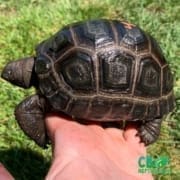
Aldabra Giant Tortoise Care Guide: Raising a Living Legend
Few animals inspire awe quite like the Aldabra giant tortoise (Aldabrachelys gigantea). Among the largest tortoises on Earth and capable of living well over a century, an Aldabra is not just a pet but a multigenerational commitment. This guide covers what it takes to raise one successfully, from a palm-sized hatchling to a gentle giant, and introduces the captive-bred Aldabra tortoises raised at www.CbReptile.com.
Natural History
Aldabra tortoises are native to the Aldabra Atoll in the Seychelles, a remote ring of coral islands in the western Indian Ocean. The atoll supports one of the largest tortoise populations in the world, estimated at around 100,000 animals, and is protected as a UNESCO World Heritage Site. Introduced and rewilded populations also exist on several other Seychelles islands and on Mauritius.
On Aldabra, the tortoises are the dominant herbivores. Their constant grazing shapes the landscape, creating a short, mixed community of grasses and herbs known as “tortoise turf.” They spend hot hours resting in shade, in shallow pools or even in caves, and are most active in the cooler morning and late afternoon.
The species is listed under CITES Appendix II, and responsible captive breeding helps supply keepers without impacting wild populations.
Appearance
Aldabras have a high, domed, dark gray to black carapace, a long neck that allows them to browse vegetation up to a meter off the ground, and thick, column-like legs. One distinguishing feature from similar giant tortoises is the presence of a nuchal scute above the neck. Hatchlings are dark with slightly lighter scute centers.

Size and Lifespan
Hatchlings measure only about 2 to 3 inches. Growth is steady over many years. Adult males can reach roughly 4 feet in shell length and weights of 400 to over 500 pounds, while females are considerably smaller. Aldabras routinely live 80 to 100 years, and some individuals are believed to have exceeded 150. Prospective keepers should have a plan for the tortoise’s care beyond their own lifetime.
Temperament
Aldabras are famously gentle and sociable. Many enjoy having their necks scratched, will extend their legs to invite attention and recognize the people who feed them. Large males can be pushy during breeding season, but they are generally peaceful companions.
Housing Hatchlings and Juveniles
Young Aldabras are best raised indoors or in a protected greenhouse until they are large enough to be safe outdoors. Provide a spacious enclosure, at least 4 x 8 feet for juveniles, with:

- A basking area of roughly 95 to 100°F and ambient temperatures of 80 to 85°F.
- Night temperatures that stay above about 70°F.
- Moderate humidity of 50 to 70 percent, with a humid hide to support smooth shell growth.
- Strong UVB from a high-output linear fixture covering much of the enclosure.
- A shallow water dish for soaking and drinking.
Housing Adults
Adult Aldabras need large outdoor grazing areas with secure, sturdy fencing, plenty of shade and a wallow or shallow pool. They are not cold-tolerant, so in most of the United States they require a heated, insulated barn or shelter whenever temperatures drop below about 60°F. Keep in mind that a full-grown Aldabra can push through weak fencing and dig under or move obstacles with ease.
Diet
Aldabras are grazers, and their diet should be high in fiber and calcium and low in sugar and protein:

- Grasses and hay should form the foundation, supplemented with grazing on safe pasture.
- Weeds and leafy greens such as dandelion, plantain, mulberry leaves, collards and endive.
- Spineless cactus pads, an excellent source of hydration and fiber.
- Occasional soaked Mazuri Tortoise Chow for juveniles.
- Fruit only as an occasional treat.
Lightly dust hatchling and juvenile meals with calcium. Rapid, protein-rich growth can lead to pyramiding and skeletal problems, so slow and steady is the goal.
Handling
Hatchlings can be lifted gently with both hands, supporting the plastron. Adults are simply too heavy to lift and should be interacted with through feeding, soaking and gentle scratches. Always supervise children around large tortoises.
Why Captive-Bred Matters
Captive-bred Aldabras arrive established on a captive diet, free from the stress of collection and shipping from abroad, and they support conservation by keeping pressure off wild and rewilded populations. If you love giant tortoises but have less space, the Sulcata tortoise is another large grazing species to consider. Our captive-bred Aldabra tortoises are raised by our team, including a staff biologist.
Frequently Asked Questions
How long do Aldabra tortoises live?
They commonly live 80 to 100 years or more, and some exceed 150. Plan for multigenerational care.
How fast do Aldabra tortoises grow?
Growth depends on diet, temperature and space. They grow steadily for decades. Avoid pushing rapid growth with rich food.
Can Aldabra tortoises live outside year-round?
Only in warm climates. In most of the United States they need a heated shelter during cooler months.
Are Aldabra tortoises friendly?
Yes. They are known for their calm, social nature and often enjoy neck and shell scratches.
Meet our captive-bred Aldabra tortoises at www.CbReptile.com.