
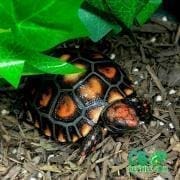
Cherry Head Tortoise Care Guide: The Colorful Red-Footed Tortoise
With bright cherry-red scales on the head and legs, the cherry head tortoise is one of the most colorful tortoises in the world. It is a form of the red-footed tortoise (Chelonoidis carbonarius) that stays a bit smaller than the standard red-foot, making it a fantastic option for keepers who want a tropical tortoise with big personality. This guide covers its care and introduces the captive-bred Cherry Head tortoises raised at www.CbReptile.com.
Natural History
Red-footed tortoises range widely across northern South America, from Colombia and Venezuela through the Guianas and into Brazil, Bolivia, Paraguay and northern Argentina, with introduced populations on several Caribbean islands. The cherry head form originates from Brazil and has long been prized for its smaller adult size and intense coloration.
Red-foots inhabit savanna edges, dry forest and humid tropical forest. They are opportunistic omnivores that forage on fallen fruit, flowers, leaves, fungi and the occasional invertebrate or carrion. They are often active after rain, when humidity is high and food is abundant.
Appearance
Cherry heads have a dark, elongated carapace often marked with yellow to orange areoles at the center of each scute. The head, forelimbs and tail carry scales that range from orange to deep cherry red, usually brighter and more extensive than in typical red-foots. Hatchlings are especially vivid. Adult males develop a concave plastron, a longer, thicker tail and often a slight “waist” in the shell.
Size and Lifespan
Hatchlings measure about 1.5 to 2 inches. Adult cherry heads typically reach 10 to 12 inches in shell length, a bit smaller than standard red-foots, which commonly grow to 12 to 14 inches. With good care they can live 50 years or more.
Temperament
Cherry heads are curious, active and food-motivated. Many learn to recognize their keepers and come running at mealtime. They are generally peaceful with one another, although males can be competitive and should be monitored when housed together.
Enclosure Setup
Hatchlings and juveniles do well in a closed chamber or a tub that holds humidity, about 4 x 2 feet to start. Adults need at least 8 x 4 feet of floor space, or a secure outdoor pen in warm climates. A Tortoise & Box Turtle Habitat Starter Kit is a convenient way to get a young tortoise set up. Include:
- A deep, humid substrate such as cypress mulch, coco coir or a blend. Eco Earth substrate holds moisture well and is easy to work with.
- Hides and plants to create sheltered, humid microclimates.
- A shallow water dish large enough for soaking.
- Sphagnum moss in hides to keep humidity high where the tortoise rests.
Heat, UVB and Humidity
Cherry heads are tropical animals. Keep ambient temperatures between 80 and 85°F with a basking spot of about 90 to 95°F. Night temperatures should not drop below about 70 to 75°F. Provide UVB from a linear tube across a large portion of the enclosure, with shaded areas so the tortoise can control its exposure.
Humidity is critical. Aim for 70 to 80 percent or higher, especially for hatchlings and juveniles. Proper humidity supports hydration and helps prevent pyramiding, the abnormal raised growth of shell scutes. Mist daily and keep the substrate damp beneath the surface without making it soggy.
Diet
Unlike grassland tortoises, red-foots and cherry heads are true omnivores. A balanced diet includes:
- Greens and weeds (about 60 to 70 percent): dandelion, collards, mustard greens, endive, mulberry and hibiscus leaves.
- Fruit (about 20 to 30 percent): papaya, mango, berries, figs, melon and prickly pear fruit.
- Protein (about 5 percent): earthworms or a small amount of other lean animal protein, offered roughly once a week or less.
- Extras: edible flowers, mushrooms, squash and soaked tortoise pellets.
Dust food with calcium a few times per week and provide a cuttlebone for adults to nibble.
Handling
Support the tortoise with both hands under the plastron and keep it low to the ground. Brief handling is fine, but tortoises are generally happiest exploring rather than being held. Wash your hands afterward.
Why Captive-Bred Matters
Captive-bred cherry heads are raised from hatch in proper humidity, which gives them smoother shells and stronger health than imported animals. Captive breeding also reduces collection pressure on wild populations. If you love this group, our Red Footed tortoises are another rewarding choice. Our captive-bred cherry head tortoises are raised by our team, including a staff biologist.
Frequently Asked Questions
Are cherry head tortoises a separate species?
No. They are a smaller, brightly colored form of the red-footed tortoise originating in Brazil.
How big do cherry head tortoises get?
Most adults reach 10 to 12 inches, slightly smaller than standard red-footed tortoises.
Do cherry head tortoises need high humidity?
Yes. Humidity of 70 to 80 percent or higher is important for hydration and smooth shell growth.
Can cherry head tortoises eat fruit?
Yes. As omnivores from tropical forests, fruit can make up roughly 20 to 30 percent of their diet.
Meet our captive-bred cherry head tortoises at www.CbReptile.com.