

Burmese Black Mountain Tortoise Care Guide: Asia’s Largest Tortoise
The Burmese black mountain tortoise (Manouria emys phayrei) is the largest tortoise native to mainland Asia and one of the most remarkable chelonians in captivity. Dark, massive and surprisingly personable, it thrives in cool, humid conditions that set it apart from the desert and savanna tortoises most keepers know. This guide explains how to meet its unique needs and introduces the captive-bred Burmese black mountain tortoises raised at www.CbReptile.com.
Natural History
Manouria emys is found in the tropical and subtropical hill forests of Southeast Asia. Two subspecies are recognized. The northern black form, M. e. phayrei, ranges through Myanmar, northeastern India, Bangladesh and western Thailand, while the southern brown form, M. e. emys, occurs farther south through peninsular Thailand, Malaysia, Sumatra and Borneo. Our Burmese Brown Mountain tortoise represents the southern subspecies.
These tortoises live on damp forest floors, near streams and in areas with deep leaf litter. They are most active in the early morning, late afternoon and after rain. The genus Manouria is considered one of the most ancestral lineages of living tortoises, and mountain tortoises display a behavior unique among tortoises: females scrape leaf litter into a mound nest, lay their eggs inside and then actively guard the nest for days.
Wild populations face heavy pressure from habitat loss and collection for food. The species is protected under CITES Appendix II and is assessed as threatened by the IUCN, which makes responsible captive breeding especially important.
Appearance
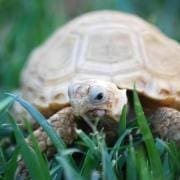
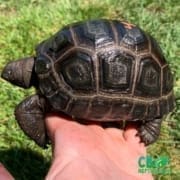
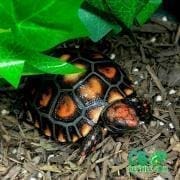
Black mountain tortoises have a broad, relatively flat, dark carapace that is nearly black in adults. Hatchlings are brown with lighter markings and darken as they mature. A distinctive feature is the divided supracaudal (tail) scute and the enlarged, pointed scales on the forelimbs, which give the legs an armored appearance. The thigh areas bear prominent spurs, which helped earn the species the alternate name Asian forest tortoise.
Size and Lifespan
Hatchlings start around 2 to 3 inches but grow quickly with proper care. Adults commonly reach carapace lengths of 18 to 24 inches and weights of 40 to 70 pounds or more, with large males of the black subspecies exceeding that. Like most large tortoises, they are long-lived, and lifespans of 50 years or more can be expected with good husbandry.
Temperament
Mountain tortoises are known for their bold, inquisitive personalities. Many recognize their keepers, approach at feeding time and enjoy gentle shell and neck scratches. Despite their size, they are generally peaceful and do well in groups when given enough space.
Enclosure Setup
Hatchlings and juveniles do best in a large indoor enclosure or closed chamber that holds humidity, such as a 4 x 2 foot setup for small juveniles, scaling upward rapidly. Adults need a very large outdoor pen in warm, humid climates or a dedicated indoor room in cooler areas. Key features include:
- Deep, moisture-retaining substrate such as cypress mulch, coco coir and leaf litter. A forest-style blend like Zoo Med Forest Floor works well for young tortoises.
- A large, shallow water area where the tortoise can soak fully. These tortoises spend a lot of time wallowing.
- Plenty of shaded cover, hides and dense planting.
- A heated shelter for outdoor animals when temperatures drop.
Heat, UVB and Humidity
Unlike sulcatas and leopards, mountain tortoises prefer moderate temperatures. Aim for daytime temperatures between 70 and 85°F with a gentle warm area of around 85 to 88°F. Avoid prolonged temperatures above 90°F, which can stress these forest-adapted animals. Nights in the mid 60s to low 70s are well tolerated.
Humidity should be high, roughly 70 to 90 percent. Mist regularly and keep the lower substrate damp but not waterlogged. Provide UVB from a linear tube over part of the enclosure, with ample shade so the tortoise can self-regulate exposure, mimicking dappled forest light. Outdoors, natural sunlight filtered through plants is ideal.
Diet
In the wild, mountain tortoises eat a broad diet of vegetation, fallen fruit, fungi and occasional invertebrates. In captivity, base the diet on:
- Dark leafy greens, weeds and edible plants such as dandelion, mulberry leaves, hibiscus, collards and endive.
- Vegetables such as squash and bell pepper.
- Fruit in moderation, often around 10 to 15 percent of the diet.
- A quality soaked tortoise pellet like Mazuri Tortoise Chow as a supplement.
Lightly dust food with calcium, especially for growing juveniles, and always provide fresh water for soaking and drinking.
Handling
Adults are heavy, so lift with both hands from the sides and keep them close to the ground. Young tortoises tolerate brief handling well, but they are happiest exploring their enclosures. Interaction through hand feeding and gentle scratches is often more rewarding than lifting.
Why Captive-Bred Matters
Wild-collected Manouria frequently arrive dehydrated and heavily parasitized, and many historically failed to adjust to captivity. Captive-bred hatchlings are healthier, already feeding and help protect vulnerable wild populations. Our captive-bred black mountain tortoises are raised by our team, including a staff biologist.
Frequently Asked Questions
How big do Burmese black mountain tortoises get?
Adults typically reach 18 to 24 inches and 40 to 70 pounds or more, making them one of the larger tortoises kept by hobbyists.
Do mountain tortoises need high heat?
No. They prefer moderate temperatures in the 70s and low 80s with high humidity. Excess heat can be harmful.
What is the difference between black and brown mountain tortoises?
They are two subspecies. The black form (phayrei) is darker and generally larger; the brown form (emys) is lighter and comes from farther south.
Can mountain tortoises live outdoors?
Yes, in warm, humid climates with heated shelter available. In cooler regions they need indoor housing for much of the year.
Meet our captive-bred Burmese black mountain tortoises at www.CbReptile.com.


Leave a Reply
Want to join the discussion?Feel free to contribute!